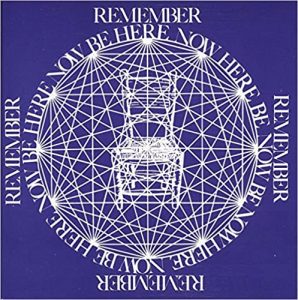
This is a book summary of Be Here Now by Ram Dass (formerly Dr. Richard Alpert, Ph.D) (Amazon):
Quick Housekeeping:
- All content in “quotation marks” is from the author (otherwise it’s paraphrased).
- All content is organized into my own themes (not the author’s chapters).
- Emphasis has been added in bold for readability/skimmability.
Book Summary Contents:
- Life Journey (3 Stages)
- Rational Mind & Attachment
- Awakening & Enlightenment
- Here & Now
- Ego, Roles, & God’s Will
- “Paradoxes”

The Spiritual Journey: Be Here Now by Ram Dass (Book Summary)
Life Journey (3 Stages)
“There are three stages in this journey that I have been on! The first, the social science stage; the second, the psychedelic stage; and the third, the yogi stage. They are summating—that is, each is contributing to the next. It’s like the unfolding of a lotus flower. Now, as I look back, I realize that many of the experiences that made little sense to me at the time they occurred were prerequisites for what was to come later.”
Stage 1: Social Science
“I was really driven. Until you know a good, Jewish middleclass, upwardly mobile, anxiety-ridden neurotic, you haven’t met a real achiever! … Everytime I went to a family gathering, I was the boy who made it. I was a Professor at Harvard and everybody stood around in awe and listened to my every word, and all I felt was that horror that I knew inside that I didn’t know.”
- “In 1961, the beginning of March, I was at perhaps the highest point of my academic career. I had just returned from being a visiting professor at the University of California at Berkeley: I had been assured of a permanent post that was being held for me at Harvard, if I got my publications in order. I held appointments in four departments at Harvard—the Social Relations Department, the Psychology Department, the Graduate School of Education, and the Health Service (where I was a therapist); I had research contracts with Yale and Stanford. In a worldly sense, I was making a great income and I was a collector of possessions. I had an apartment in Cambridge that was filled with antiques and I gave very charming dinner parties. I had a Mercedes-Benz sedan and a Triumph 500 CC motorcycle and a Cessna 172 airplane and an MG sports car and a sailboat and a bicycle. I vacationed in the Caribbean where I did scuba-diving. I was living the way a successful bachelor professor is supposed to live in the American world of ‘he who makes it.’ I wasn’t a genuine scholar, but I had gone through the whole academic trip. I had gotten my Ph.D.; I was writing books. I had research contracts. I taught courses in Human Motivation, Freudian Theory, Child Development. But what all this boils down to is that I was really a very good game player.”
- “Before March 6th, which was the day I took Psylocybin, one of the psychedelics, I felt something was wrong in my world, but I couldn’t label it in any way so as to get hold of it. I felt that the theories I was teaching in psychology didn’t make it, that the psychologists didn’t really have a grasp of the human condition, and that the theories I was teaching, which were theories of achievement and anxiety and defense mechanisms and so on, weren’t getting to the crux of the matter.”
- “Something was wrong. And the something wrong was that I just didn’t know, though I kept feeling all along the way that somebody else must know even though I didn’t. The nature of life was a mystery to me. All the stuff I was teaching was just like little molecular bits of stuff but they didn’t add up to a feeling anything like wisdom. I was just getting more and more knowledgeable.”
Stage 2: Psychedelics
“We’d sit around on Saturday night and say, ‘What should we do?’ and we all knew what we were going to do, and we would ‘turn on.’ We were exploring this inner realm of consciousness that we had been theorizing about all these years and suddenly we were traveling in and through and around it … These experiences quickly became indescribable. I’d get to a point with my colleagues when I couldn’t explain any further, because it came down to ‘To him who has had the experience no explanation is necessary, to him who has not, none is possible.'”
His personal experience:
- “I realized that although everything by which I knew myself, even my body and this life itself, was gone, still I was fully aware! Not only that, but this aware ‘I’ was watching the entire drama, including the panic, with calm compassion.”
- “I felt a new kind of calmness—one of a profundity never experienced before. I had just found that ‘I’, that scanning device—that point—that essence—that place beyond. A place where ‘I’ existed independent of social and physical identity. That which was I was beyond Life and Death. And something else—that ‘I’ Knew—it really Knew. It was wise, rather than just knowledgeable. It was a voice inside that spoke truth. I recognized it, was one with it, and felt as if my entire life of looking to the outside world for reassurance was over. Now I need only look within to that place where I Knew.”
Step ladder of psychedelic experience (“a kind of probabilistic hierarchy of experience”):
- “The most likely experience everybody had was a heightened sensitivity to all of their five senses and speeding up of the thought process.”
- “The next type of experience that people would frequently report was an interpersonal shift of figure and ground, where they would look at another person and see the way in which the other person was similar, rather than different from themselves. And it was as if the whole western mind-training of individual differences had been made background instead of figure, so that you’d look at another human being and say, ‘Here we are.’ You’d see differences more as clothing, rather than as core stuff. This was a profound perceptual experience for many people.”
- “Then there was a still less frequent type of experience reported: a oneness, in which subjects would say, ‘ . . . I remember being in a dark room with another person and one of us spoke and one of us said, ‘Who spoke, you or me?’ It wasn’t clear from who’s mouth the words came.”
- “And then there was a still less frequent experience where one looked at somebody and he started to see the other person as cellular structure or patterns of energy rather than as a person.”
- “And finally, a few subjects (maybe 3% or something like that) transcended all form and saw just pure energy—a homogeneous field. It has been called the White Light.”
Coming down from psychedelics:
- “The coming down matter is what led me to the next chapter of this drama. Because after six years, I realized that no matter how ingenious my experimental designs were, and how high I got, I came down.”
- “It was a terribly frustrating experience, as if you came into the kingdom of heaven and you saw how it all was and you felt these new states of awareness, and then you got cast out again.”
- “If you see yourself as God and then you come back from this state and somebody says, ‘Hey, Sam, empty the garbage!’ it catches you back into the model of ‘I’m Sam who empties the garbage.’ You can’t maintain these new kinds of structures. It takes a while to realize that God can empty garbage.”
Stage 3: Yogi
“I left to go to India, and I took a bottle of LSD with me, with the idea that I’d meet holy men along the way, and I’d give them LSD and they’d tell me what LSD is. Maybe I’d learn the missing clue … I don’t know how to describe this to you, except that I was deep in my despair; I had gone through game, after game, after game, first being a professor at Harvard, then being a psychedelic spokesman, and still people were constantly looking into my eyes, like ‘Do you know?’ Just that subtle little look, and I was constantly looking into their eyes—’Do you know?’ And there we were, ‘Do you?’ ‘Do you?’ ‘Maybe he . . .’ ‘Do you . . . ?’ And there was always that feeling that everybody was very close and we all knew we knew, but nobody quite knew. I don’t know how to describe it, other than that.”
Following Bhagwan Dass (Wikipedia):
- “During these travels he’s starting to train me in a most interesting way. We’d be sitting somewhere and I’d say, ‘Did I ever tell you about the time that Tim (Leary) and I . . .’ And he’d say, ‘Don’t think about the past. Just be here now.’ Silence. And I’d say, ‘How long do you think we’re going to be on this trip?’ And he’d say, ‘Don’t think about the future. Just be here now.'”
- “He had just sort of wiped out my whole game. That was it—that was my whole trip—emotions, and past experiences, and future plans.”
- “There was no conversation. I didn’t know anything about his life. He didn’t know anything about my life. He wasn’t the least bit interested in all of the extraordinary dramas that I had collected . . . He was the first person I couldn’t seduce into being interested in all this. He just didn’t care. And yet, I never felt so profound an intimacy with another being. It was as if he were inside of my heart. And what started to blow my mind was that everywhere we went, he was at home.”
Following Maharaji / Neem Karoli Baba (Wikipedia):
- “Some time later we were back with the Maharaji and he said to me, ‘Come here. Sit.’ So I sat down and he looked at me and he said, ‘You were out under the stars last night.’ ‘Um-hum.’ ‘You were thinking about your mother.’ ‘Yes.’ (‘Wow,’ I thought, ‘that’s pretty good. I never mentioned that to anybody’.) ‘She died last year.’ ‘Um-hum.’ ‘She got very big in the stomach before she died.’ . . . Pause . . . ‘Yes.’ He leaned back and closed his eyes and said, ‘Spleen. She died of spleen.'”
- “Well, what happened to me at that moment, I can’t really put into words. He looked at me in a certain way at that moment, and two things happened—it seemed simultaneous. They do not seem like cause and effect. The first thing that happened was that my mind raced faster and faster to try to get leverage—to get a hold on what he had just done. I went through every super CIA paranoia I’ve ever had: ‘Who is he?’ ‘Who does he represent?’ ‘Where’s the button he pushes where the file appears?’ and ‘Why have they brought me here?’ None of it would jell. It was just too impossible that this could have happened this way. The guy I was with didn’t know all that stuff, and I was a tourist in a car, and the whole thing was just too far out. My mind went faster and faster and faster.”
- “My mind went faster and faster and then I felt like what happens when a computer is fed an insoluble problem; the bell rings and the red light goes on and the machine stops. And my mind just gave up. It burned out its circuitry . . . its zeal to have an explanation. I needed something to get closure at the rational level and there wasn’t anything. There just wasn’t a place I could hide in my head about this. And at the same moment, I felt this extremely violent pain in my chest and a tremendous wrenching feeling and I started to cry. And I cried and I cried and I cried. And I wasn’t happy and I wasn’t sad. It was not that kind of crying. The only thing I could say was it felt like I was home. Like the journey was over. Like I had finished.”
Rational Mind & Attachment
“Man is presently caught in a plane of consciousness which is nourished by the workings of his rational mind. That is, the plane of polarities . . . of good and evil . . . and left and right . . . of old and young . . . of us and them . . . and of man and woman.”
Rational mind:
“What you may not understand is: the whole game you have been playing is also based on faith you have had—faith in the rational mind. We are living in a society which is a temple dedicated to the rational man.”
- “In an evolutionary perspective, the rational mind takes us a certain distance and no further, and we must be able to transcend it, to go on to other ways, other vehicles, if we are to cross the great ocean.”
- “If you sense the limitations of a specific tool you do not necessarily throw the tool away. You first explore whether there is a way of using this very powerful tool in such a way as to develop a better tool or vehicle. That is, can you use the rational mind to transcend itself? The answer is yes. And the technique is known as jnana yoga, or the path of knowledge arrived at through reasoning and discrimination.”
- “Using the rational mind is making use of great powers which can lead to freedom or to greater enslavement. To understand the risk involved in jnana yoga you need to reflect upon the precise limit of the rational mind. The rational mind functions by separating subject from object, that is, the knower from the known.”
Attachment:
“To be ‘not caught’ means to be unattached. To be unattached does not mean to be uninvolved, it means to be involved ‘without attachment.'”
- “A conscious being is capable of making as many discriminations among components of the Universe as anyone else (perhaps even more). However, he is not caught in them. Just because you are seeing divine light, experiencing waves of bliss, or conversing with Gods and Goddesses is no reason to not know your zip code. Keeping it together means keeping conscious at all levels—all planes—with no attachment to any of them.”
- “You do your thing. Live your life in the world. The water goes on down the stream. You chop the wood and carry the water. You do your thing, your mind does its thing. Your senses their thing, but you are not attached.”
- “As you extricate yourself from your attachments and become quiet, you will be able to know more and more clearly how it all is . . . The Way.”
Awakening & Enlightenment
“This is what man’s journey into Consciousness is all about. This is Om (home). It’s going Om. This is the Place! Becoming one with God. It’s the return to the roots that the tao talks about.”
Awakening:
“Everyone’s needs are different and everyone is at a different stage along the path … If you listen to your own inner voice, it will tell you where you are now, and which method will work best for you in your evolution towards the light … You’ve got to go at the rate you can go. You wake up at the rate you wake up. You’re finished with your desires at the rate you finish with your desires.”
- “I saw that my whole game didn’t work. It gave me all the rewards that seemed to be offered but it didn’t work. There was a place in me that knew it wasn’t working. I knew there was something else but I couldn’t get to it. At that point I gave up. And then I was ready for the next message … The next message is where you are when you hear the next message. Whenever you’re ready, you’ll hear the next message. The interesting thing is theres always a next message and its always available to you.”
- “The journey across the great ocean of existence is a journey inward ever in deeper and deeper—and the deeper you get in the more you meet truth.”
- “When your center is firm, when your faith is strong and unwavering, then it will not matter what company you keep. Then you will see that all beings are on the evolutionary journey of consciousness. They differ only to the degree that the veil of illusion clouds their vision. But for you . . . you will see behind the veil to the place where we are all ONE.”
Enlightenment:
“We are all on the journey towards enlightenment and at each stage must share what has been discovered with those who will listen. The sharing is part of the work. The listening is part of the work. We are all on the path.”
- “Your understanding of what the universe is all about changes as you proceed further along the path towards enlightenment. As your vantage point or perspective changes, you begin to understand more and more of ‘how it is.’ With this greater understanding comes greater compassion . . . an acceptance of ‘how it is’ . . . an ability to see the divine plan in everything . . . even in your failings and the failings of others.”
- “The major obstacle at every stage of the path of enlightenment is our own thoughts. Thoughts keep us separate. Even the thought of Unity is far different from Unity. And the thoughts keep coming; each one making its bid for our attention and identification.”
- “You become aware of the inevitable process of the evolution of consciousness . . . that daily, slowly, the cloud of illusion becomes thinner and thinner . . . until, at last, there is light.”
Here & Now
“If we’re not in the here & now, no matter how much food we put in our bellies, it’s never going to be enough—that’s the feeling of western man. It’s not enough. He’s got it all going in as fast as he can shovel it. He’s got every sensual gratification he can possibly desire. It’s not enough because there’s no Here & Nowness about it.”
Here:
“The message is that you don’t need to go to anywhere else to find what you are seeking.”
- “Where do we begin? The answer is simple: you begin just where you are.”
- “When you know how to listen, everybody is the guru speaking to you. It’s right here . . . always.”
- “What blows your mind is you were here all the time, and it’s such a cosmic joke—it’s so funny you’re struggling so to get here.”
Now:
“What are you doing? Planning for the future? Well it’s all right now.”
- “But later?. . . . . . . . . . . . . . . . . . . . . . forget it baby. That’s later. Now is Now.”
- “Your thoughts are still in time and space, and you can’t get out of time through them.”
- “Are you going to be here? Or not? It’s as simple as that!”
Ego, Roles, & God’s Will
“If you could stand back far enough and watch the whole process you would see You Are A Totally Determined Being. The very moment you will wake up Is Totally Determined. How long you will sleep Is Totally Determined. What you will hear of what I say Is Totally Determined. There are no accidents in this business at all. Accidents are just from where you’re looking. To the ego, it looks like it’s miracles and accidents. No miracles. No accidents. It’s just your vantage point that you’re sort of. . . . .stuck in.”
Ego:
“Man’s rational mind, the instrument with which he can think about things, has given him great power. This power he has used primarily to increase his potential for survival, to increase his pleasure or sensual gratification, and to enhance his ego through mastery or control of his environment.”
- “The psychosis business is an interesting business if you go through the doorway too fast and you’re not ready for it. You’re bound hand and foot and thrown into outer darkness. You may land anywhere, and lots of people end up in mental hospitals. The reason they do is: they went through the door with their ego on and: ‘Wow! I’ve been invited to the wedding feast. I mean dig me! Sam Jones! Sam Jones in Heaven! Sam Jones standing on the right side of the Lord. There’s the Lord, and there’s Gabriel, and there’s Sam Jones.’ They don’t understand that you gotta die to be born. That only when you have been born again do you enter the kingdom of heaven. So, they’ve gone in on the first round, and what happens is they go on a huge ego trip. It’s called: The Messianic Complex. It’s called: Paranoia. Delusions of grandeur.”
- “Many of the greatest minds in history have gotten caught in this trap of wanting to be God and at the same time to retain their separate identity. They are caught because they still have energy attached to the third chakra, the desire for ego power. And to be God is obviously the ultimate power trip.”
- “You come to a point where you almost know it all. You are very wise. You are very pure . . . except for the fact that you may well have gotten caught in the last trap . . . the desire to know it all and still be you, ‘the knower.’ This is an impossibility. For all of the finite knowledge does not add up to the infinite. In order to take the final step, the knower must go. That is, you can only BE it all, but you can’t know it all. The goal is non-dualistic—as long as there is a ‘knower’ and ‘known’ you are in dualism.”
Roles:
“Play your role in the Divine Dance, but know it to be such and worship its divinity.”
- “Suitable right livelihood for any specific individual is determined by the totality of forces acting upon him. These forces (vectors) include social, cultural, economic, hereditary, and experiential factors. To hear the way in which the interplay of all these forces determines your right livelihood requires much calming of the mind. The quieter you become the more you can hear. As you progress with your sadhana you may find it necessary to change your occupation. Or you may find that it is only necessary to change the way in which you perform your current occupation in order to bring it into line with your new understanding of how it all is. The more conscious that a being becomes, the more he can use any occupation as a vehicle for spreading light. The next true being of Buddha-nature that you meet may appear as a bus driver, a doctor, a weaver, an insurance salesman, a musician, a chef, a teacher, or any of the thousands of roles that are required in a complex society—the many parts of Christ’s body. You will know him because the simple dance that may transpire between you—such as handing him change as you board the bus—will strengthen in you the faith in the divinity of man. It’s as simple as that.”
- “What about helping suffering people … Sure. Do it. It’s karma yoga. But do it without attachment. To be attached means that you identify with your role as the GIVER of help. This in turn casts the other person in the role of the RECEIVER of help. Such identification with roles may fill bellies, but it increases human distance. A conscious being knows that there is neither giver nor receiver . . . there are only empty bellies, storehouses of wheat . . . and effort required to move the wheat from the storehouses to the belly. It is OUR wheat, OUR belly, OUR effort. And when all this energy has been transferred, a conscious being realizes that nothing has happened. Thanks are absurd . . . does your left hand thank your right hand?”
- “There is writing happening. Maybe thats hard for you to understand. I am here but ‘I’ am not here. I am writing but ‘I’ am not writing.”
God’s will:
“The simple rule of the game, repeated in the most profound mystical texts, reminds us that it is not my but THY will, O Lord . . . not my trip but THY Trip.”
- “You do what you do because that’s what the harmony of the universe requires. If I am a potter, I make pots. But who is making the pots? I am not under the illusion that I am making the pots. Pots are. The potter is.”
- “You do what you do, but you do not identify with the doing of it. All ‘doing’ is happening as part of the dance of nature . . . and though your body and mind speed about their business, you remain in your calm center . . . HERE . . . ‘where we all are.'”
- “Do you think that when Christ is lying there and they’re nailing the nails in, He’s saying, ‘Oh man, does that hurt!’? He’s probably looking at the guy who’s nailing him with absolute compassion. He digs why the cat’s doing it. What he’s stuck in. How much dust covers his eyes. Why he’s got to be doing it. That’s the way it is.”
“Paradoxes”
“(The rational mind’s) limitations are that it cannot handle paradoxical or illogical information (e.g., that points at the opposite ends of a continuum are the same point, or that something can be ‘a’ and ‘not a’ at the same time) and that it cannot know that which can only be experienced subjectively.”
- “The most exquisite paradox: as soon as you give it all up, you can have it all.”
- “To think that working on oneself requires ‘dropping-out’ of society is to miss the point. Certainly you must drop out . . . but the drop-out is internal, not external. One drops out of one’s attachments; one drops out of one’s identification with the illusion of separateness.”
- “I can do nothing for you but work on myself. You can do nothing for me but work on yourself.”
- “It’s a little more like the image of a caterpillar—enclosing itself in a cocoon in order to go through the metamorphosis to emerge as a butterfly. The caterpillar doesn’t say: ‘well, now I’m going to climb into this cocoon and come out a butterfly.’ It’s just an inevitable process. It’s inevitable. It’s just happening. It’s got to happen that way. We’re talking about a metamorphosis, we’re talking about going from a caterpillar to butterfly, we’re talking about how to become a butterfly. I mean the caterpillar isn’t walking around saying: ‘man, I’ll soon be a butterfly.’ Because as long as he’s busy being a caterpillar, he can’t be a butterfly. It’s only when caterpillarness is done that one starts to be a butterfly. And, that again is part of this paradox: you cannot rip away caterpillarness. The whole trip occurs in an unfolding process under which you have no control.”
You May Also Enjoy: