Sign up to get the Sloww Sunday newsletter via email for free:👇

Sloww Sunday Newsletter 232 (Mar 15, 2026) — Quitting Alcohol (Again), Waking Up, & More
The Sloww Sunday newsletter sends to 10,000+ readers slowing down to the wisdom within. If you enjoy this issue, please help grow Sloww by forwarding this newsletter to others.
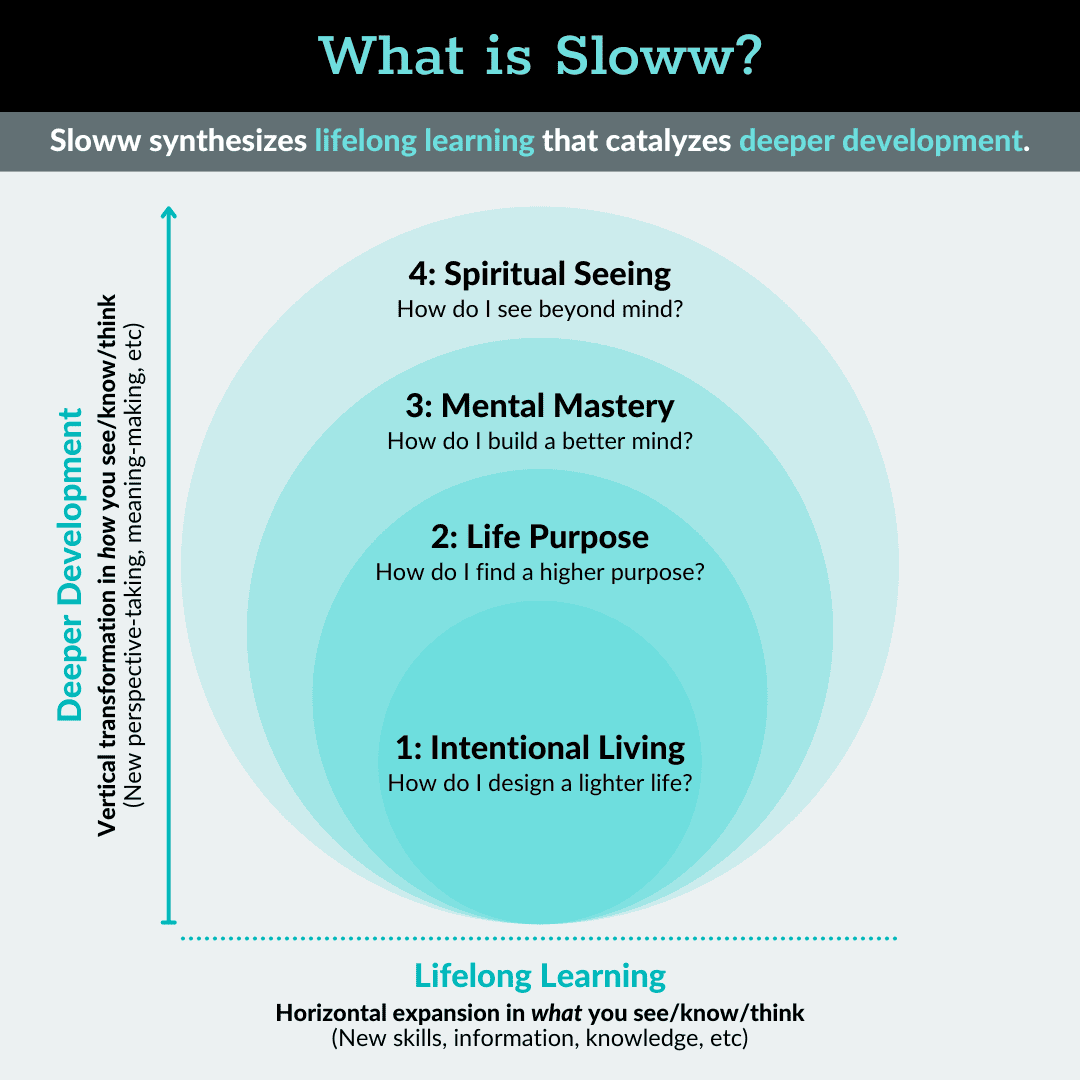
New to Sloww? Here’s what it’s about in a nutshell (which mirrors the newsletter sections below):
🤔 (More) weirdness of thinking
The last newsletter highlighted philosopher Galen Strawson on the weirdness of thinking. If we pay attention to our moment-to-moment experience, it becomes clear that thinking just happens—and then we attribute it to ourselves (‘I’) by saying things like, ‘I’m thinking.’ It turns out Nietzsche noticed the same thing:
- “A thought comes when ‘it’ wishes, and not when ‘I’ wish, so that it is a falsification of the facts of the case to say that the subject ‘I’ is the condition of the predicate ‘think.’ It thinks; but that this ‘it’ is precisely the famous old ‘ego’ is, to put it mildly, only a supposition, an assertion, and assuredly not an ‘immediate certainty.’ After all, one has even gone too far with this ‘it thinks’—even the ‘it’ contains an interpretation of the process, and does not belong to the process itself. One infers here according to the grammatical habit: ‘Thinking is an activity; every activity requires an agent; consequently—'”
- “When I analyze the process that is expressed in the sentence, ‘I think,’ I find a whole series of daring assertions that would be difficult, perhaps impossible, to prove; for example, that it is I who think, that there must necessarily be something that thinks, that thinking is an activity and operation on the part of a being who is thought of as a cause, that there is an ‘ego,’ and, finally, that it is already determined what is to be designated by thinking—that I know what thinking is.”
- “Formerly, one believed in ‘the soul’ as one believed in grammar and the grammatical subject: one said, ‘I’ is the condition, ‘think’ is the predicate and conditioned—thinking is an activity to which thought must supply a subject as cause. Then one tried with admirable perseverance and cunning to get out of this net—and asked whether the opposite might not be the case: ‘think’ the condition, ‘I’ the conditioned; ‘I’ in that case only a synthesis which is made by thinking.”
More quotes: 10+ Nietzsche Quotes on Self-Origination, False Causality, & More
0️⃣ Explore More: 50+ posts on Lifelong Learning & Deeper Development (Sloww Stage Support)
🧠 Featured Product: Synthesizer Course: The Flagship Course for Synthesizing Minds
🍷 I’m quitting alcohol & caffeine (again)…
I successfully completed a no-alcohol year (🔒) from April 2023 – June 2024 (kept it going for a total of 416 consecutive days). I also quit caffeine for 90 consecutive days. Now, I think it may be time to quit them both again. Why?
Someone asked if I just do challenges like this for fun. I wish! ‘Fun’ isn’t usually motivating enough for me to stick with something. There needs to be a deeper personal reason that provides sufficient motivational fuel for me to change. In the cases of alcohol and caffeine, it’s pain (headaches). I seem to get hangover-type headaches from nearly any amount of alcohol, and caffeine withdrawal headaches even if I’m only having one cup of green tea per day. So, once again, both alcohol and caffeine have become net negatives in my life that outweigh any positives from consuming them.
Maybe you’ve heard the saying ‘change happens when the pain of staying the same is greater than the pain of change’ (or in my case: Pain > Positives = Change). I’ve found this to be true for me. How about you?
More context: 🔒Behind the Scenes: Why I’m Quitting Alcohol (1 Year Later)
1️⃣ Explore More: 100+ posts on Intentional Living (Sloww Stage 1)
😃 Featured Product: The Hierarchy of Happiness: 100+ Powerful Perspectives on How to be Happy (Free eBook)
🤯 What if your primary purpose is to ‘wake up’?
- “Your inner purpose is to awaken. It is as simple as that … The true or primary purpose of your life cannot be found on the outer level. It does not concern what you do but what you are.” — Eckhart Tolle
If so:
- “If your grand purpose in life is to wake up, then whatever happens to you is good, for it can prod you into self-awakening.” — Vernon Howard
2️⃣ Explore More: 50+ posts on Life Purpose (Sloww Stage 2)
🧭 Featured Product: Ikigai 2.0: A Step-by-Step Guidebook to Finding Life Purpose & Making Money Meaningfully (+ Bonus Workbook)
🧠 The basic argument against ultimate moral responsibility
In my opinion, philosopher Galen Strawson’s ‘basic argument‘ is the clearest way to see the problems with free will and moral responsibility. Here’s the simplest version:
- “You do what you do—in the circumstances in which you find yourself—because of the way you then are.
- So if you’re going to be ultimately responsible for what you do, you’re going to have to be ultimately responsible for the way you are—at least in certain mental respects.
- But you can’t be ultimately responsible for the way you are in any respect at all.
- So you can’t be ultimately responsible for what you do.”
Or, in one sentence:
- “You’re not ultimately responsible for what you do because you didn’t make yourself the way you are.”
Why Strawson says the basic argument matters:
- “It’s a completely a priori argument … That means that you can see that it is true just lying on your couch. You don’t have to get up off your couch and go outside and examine the way things are in the physical world. You don’t have to do any science.”
- “According to the Basic Argument, it makes no difference whether determinism is true or false. We can’t be ultimately morally responsible either way.”
- “The evident consequence of the Basic Argument is that there is a fundamental sense in which no punishment or reward is ever ultimately just. It is exactly as just to punish or reward people for their actions as it is to punish or reward them for the (natural) colour of their hair or the (natural) shape of their faces.”
More versions of the basic argument: The Basic Argument against Ultimate Moral Responsibility (Galen Strawson Summary)
3️⃣ Explore More: 100+ posts on Mental Mastery (Sloww Stage 3)
🧠 Featured Product: Mini Mind: 365 Days of Bite-Size Brain Food
🤡 The clown that takes the bow
Spiritual teacher Jean Klein came up with a memorable way to see the separate self: it’s the clown that takes the bow at the end of a performance without actually performing anything. Here’s how Francis Lucille and Rupert Spira describe it:
- “My teacher (Jean Klein) used to say the mind is like a clown taking the bow after the ballerina’s performance to claim the applause … In fact, the clown didn’t dance. The thinker thought didn’t think … There is no local chooser. Obviously, things get decided somehow or happen. So, in a poetic way, we could say that the universe makes a decision.” — Francis Lucille
- “Jean Klein likened the separate self to the clown that comes onstage after the curtain has fallen to receive the applause. It’s a very nice analogy of the separate self … In retrospect, we look at the succession of thoughts … We look back and imagine that there is a ‘chooser’ in the system between each thought … It’s not actually there in between each of the thoughts. The chooser itself is not there in between each thought choosing each time between a range of possibilities: ‘I’ll have that thought next, and then I’ll have this thought.’ That chooser is not there. The notion of a chooser is simply itself a thought which appears retrospectively. The thought says, ‘I was there in between each thought choosing it.’ It’s the clown that takes the bow. It wasn’t actually present, but it claims responsibility afterwards.” — Rupert Spira
Source: The Separate Self is the Clown that takes the Bow (Jean Klein Teaching)
4️⃣ Explore More: 100+ posts on Spiritual Seeing (Sloww Stage 4)
👣 Featured Product: Wise Walk: 365 Days of Enlightening Exercise
Share: Sloww Sunday currently sends to 10,000+ students of life each week. If you enjoyed this issue, please help grow Sloww by forwarding this newsletter to some friends and family. It’s free for them to subscribe here.
Support: Sloww is a one-human labor of love (it’s just me over here 👋). Your support keeps the site ad-free and invests in me while you invest in yourself—a true win-win! There are free and financial ways to support.
All the best,
Kyle Kowalski
Founder, Sloww