This is a summary on the four quadrants (AQAL) of Integral Theory according to Ken Wilber.
This page is intended as a learning resource for educational purposes and only meant to offer an overview/introduction (content has been paraphrased and organized in my own way). Short summaries and quotes aren’t substitutes for source material, so if this page sparks your interest, explore more deeply by checking out Ken Wilber’s books (Amazon).
I’ve personally read six of Wilber’s books so far, which have been used to synthesize the summary below:
- “Finding Radical Wholeness” (Book Summary)
- “The Integral Vision” (Book Summary)
- “Integral Psychology” (Book Summary)
- “Integral Spirituality” (Book Summary)
- “A Theory of Everything” (Book Summary)
- “A Brief History of Everything” (Book Summary) + 20 Tenets of Integral Theory
The Four Quadrants (AQAL) of Integral Theory (Ken Wilber Summary)
Quadrants Overview:
The 4 basic quadrants (or dimensions/perspectives) that all humans have access to involve the most fundamental oppositions in all of existence: inside vs outside (or subject vs object) & individual vs collective (or singular vs plural).
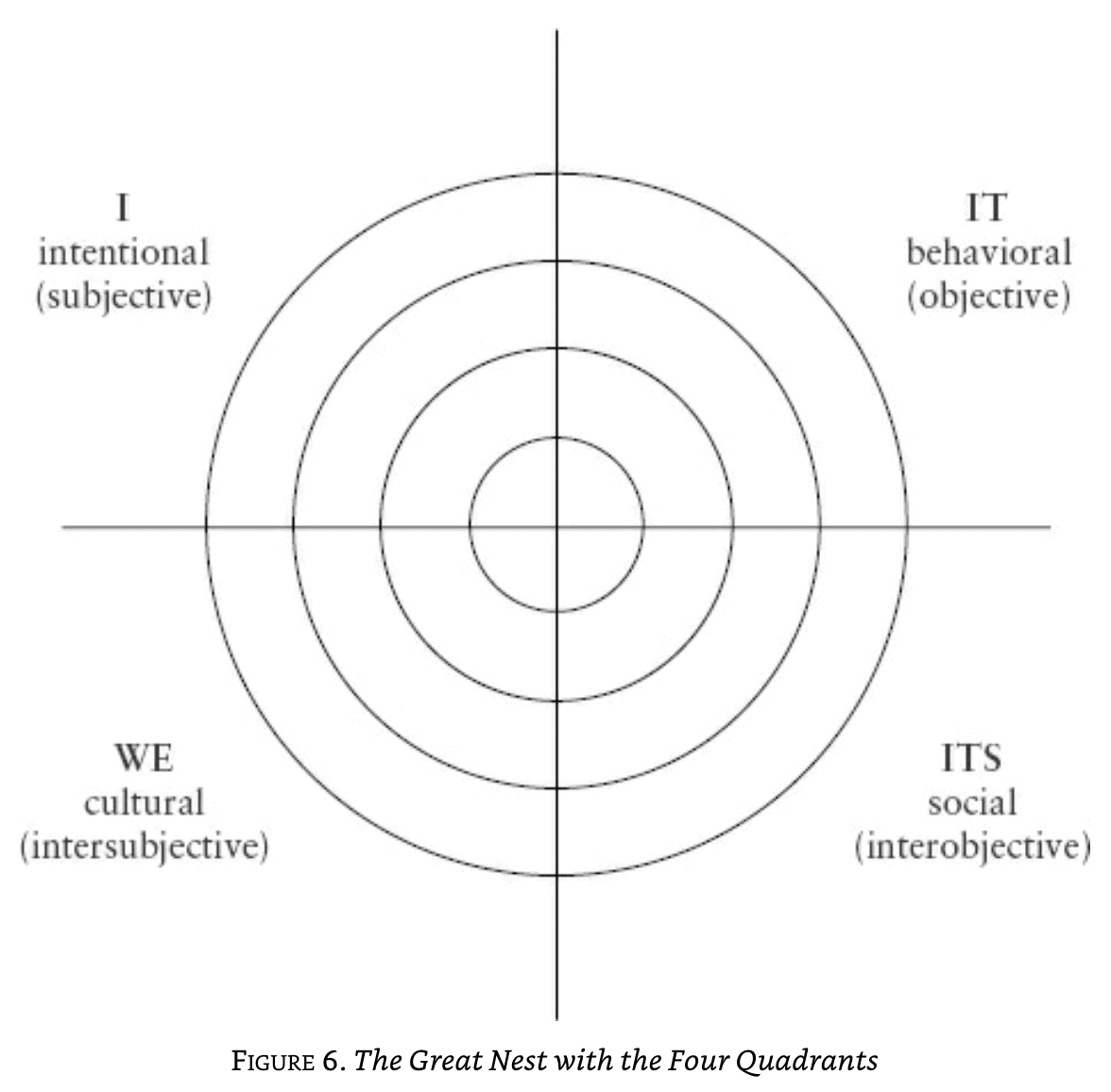
- We can’t find one of those pairs without its opposite: Subjects always arise and exist with objects, and individuals always arise and exist with collectives. Wherever there is an object reality (the exterior of an individual or collective holon), there is a subject reality (the interior of an individual or collective holon). You can’t have subjects without objects, and individual holons always exist in various groups or collective holons. It arises as a subject with various objects, and in an individual holon inextricably interwoven with a group or collective holon.
- Tetra-everything: Every phenomenon in the real world always involves all 4 quadrants. The 4 quadrants mutually arise, interact, and evolve together—they tetra-enact, tetra-interact, and tetra-evolve. Fully acknowledge, and totally inhabit, all 4 quadrants of existence—try not to deny, ignore, or reduce any of them to the others but to see all of them as equally real, equally important, and equally tetra-evolving and tetra-enacting.
- Wholeness & Nonduality: The interior and the exterior are basically two different dimensions of the same underlying Wholeness (or nonduality). All 4 quadrants are manifestations of a genuinely nondual Reality. This is the true meaning of nonduality—the subject and the object, your self and its entire environment, the seer and everything seen, you and the entire world, are fully ‘not two,’ a state of Wholeness that is truly all-inclusive, a genuinely perfect Oneness.
Left-Hand & Right-Hand Quadrants:
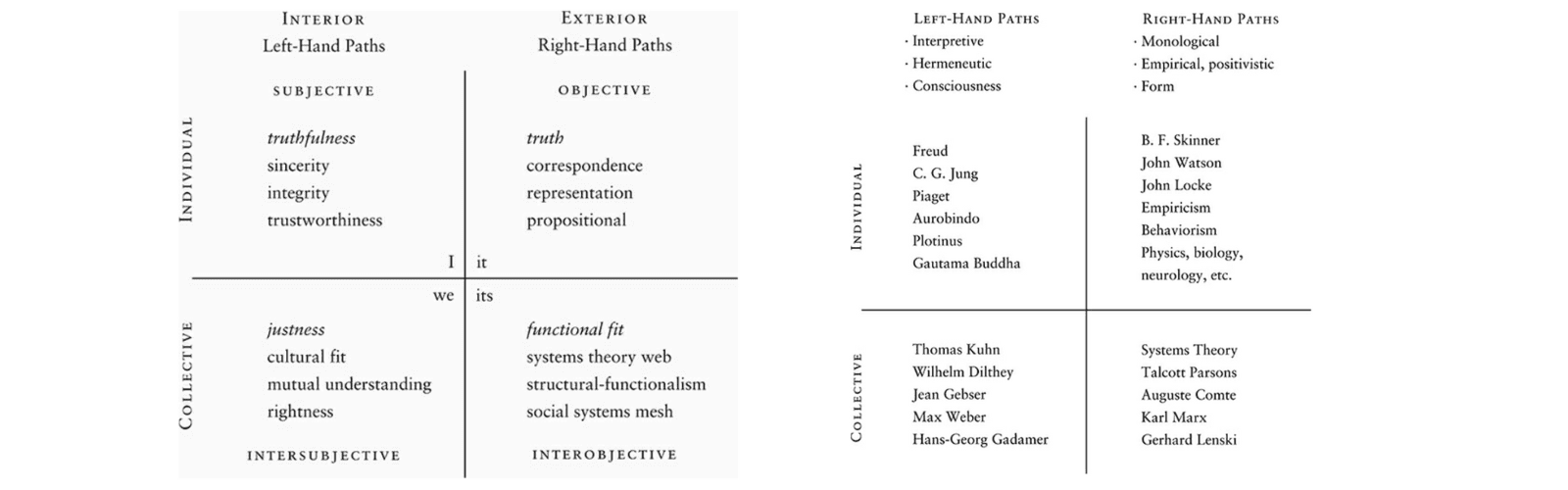
- Left Quadrants / Left-Hand Path (interior holons, 1st person subject, I/we): Focus on the interior—what the holon looks like from within (subjective, intersubjective, consciousness, depths, hermeneutic). Can only be accessed by introspection, interpretation, and communication (dialogue and dialogical approaches). Involve interpretation which is empathic resonance from within as opposed to objective staring from without (depth must be interpreted, all meaning is context dependent and contexts are boundless, the more contexts we can take into account then the richer our interpretations will be). Can be experienced but nothing in the interior dimensions can be videotaped or photographed (you cannot put your finger on anything in your mind).
- Right Quadrants / Right-Hand Path (exterior holons, 3rd person object, it/its): Focus on the exterior—what the holon looks like from without (objective, monological, empirical, positivistic, form). Involve perception and empiricism (usually thought of as scientific and propositional truth). Surfaces can be seen with the senses or their extensions like microscopes, telescopes, photographic equipment, etc, and you can photograph/videotape them (you can put your finger right on them, and in many cases actually touch them). You observe their objective behavior (atoms, or cells, or populations, or individuals, or societies, or ecosystems).
Key Concept: ‘Flatland’
Flatland (or scientific materialism, subtle reductionism): Belief that only the Right-Hand quadrants are real (that only matter is real, and that only narrow science has any claim to truth). Reducing the Left-Hand dimensions to their Right-Hand correlates (‘I’ and ‘we’ into a flatland system of just ‘its’). Collapsing all interior depths into exterior span and all values into functional fit. Reducing all translogical and all dialogical to monological. Gutting the interiors of the entire Kosmos.
Irreducible & Interconnected: There is a constant attempt to try to reduce one quadrant to another, and Integral maintains that’s not possible because all 4 quadrants are deeply interwoven and correlated.
AQAL Overview:
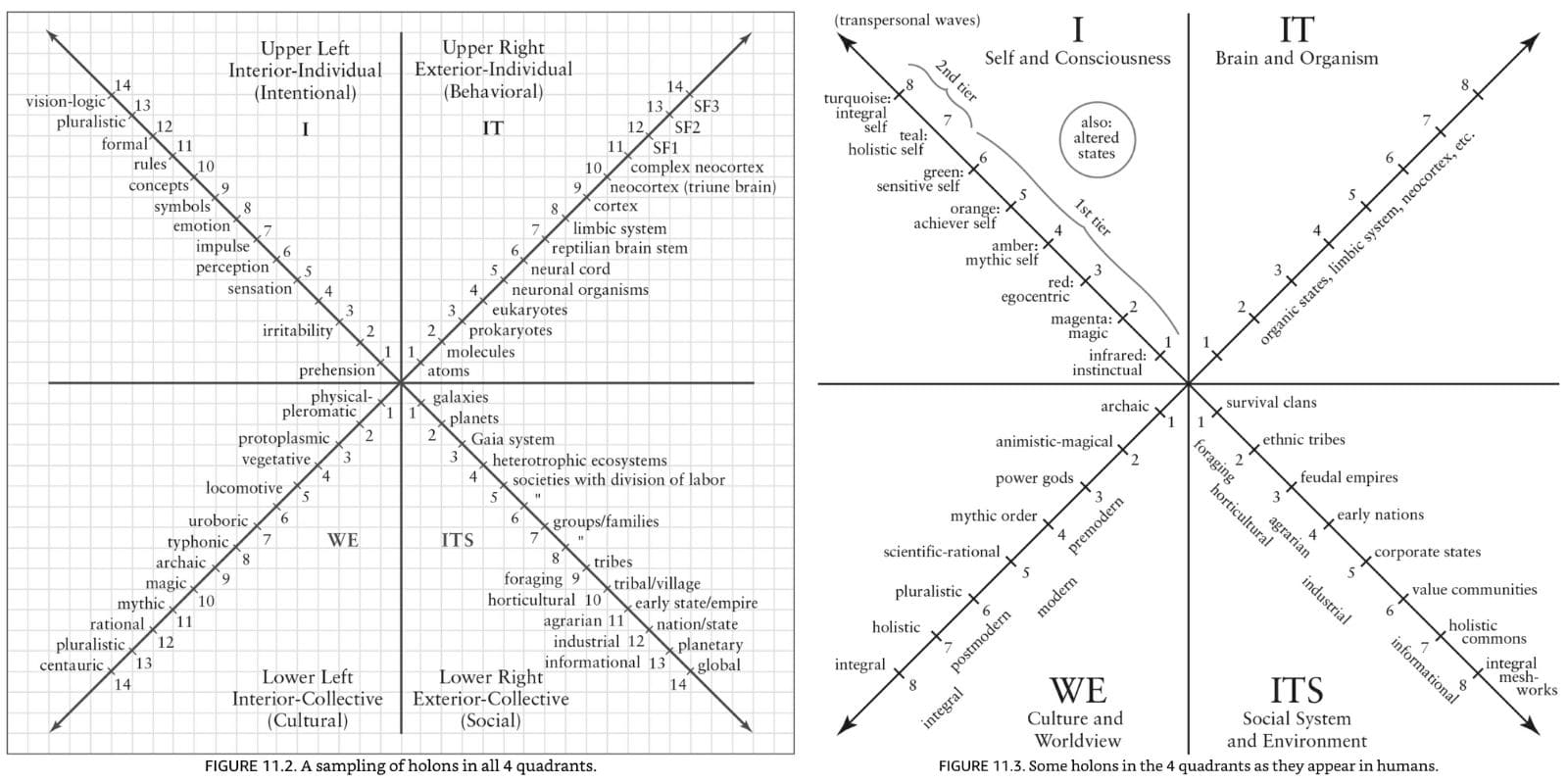
AQAL: All Quadrants, All Levels (or All Quadrants, All Levels, All Lines, All States, All Types)
In order to have a truly integral view, we want to take the very best of the ancient wisdom (it was ‘all-level’ stretching from body to mind to soul to spirit) and combine that with the very best of modernity (it was ‘all-quadrant’ differentiating I, we, it/its), and thus arrive at an all-level, all-quadrant vision. The point of an ‘all-quadrant, all-level’ approach is that it would honor all of the waves of existence—from body to mind to soul to spirit—as they all unfold in self, culture, and nature.
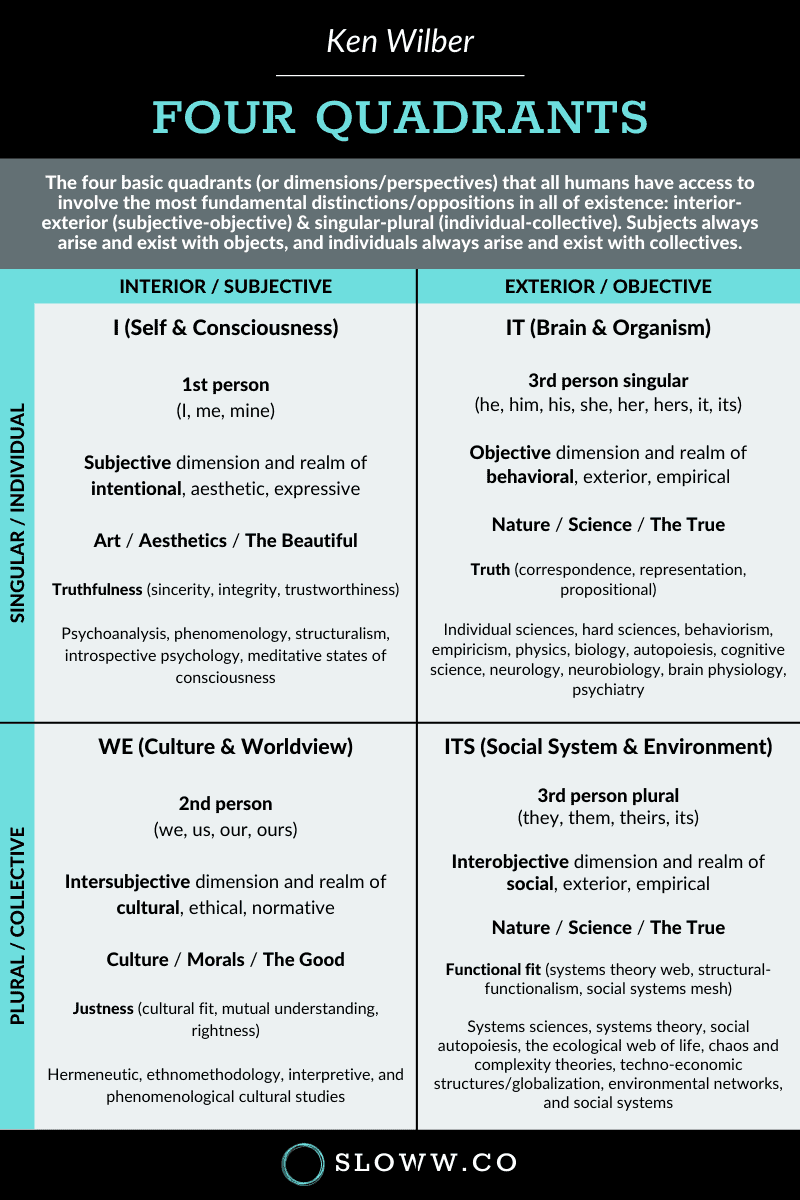
Upper-Left Quadrant (UL):
- ‘I’ / Self / 1st Person (I, me, mine): How ‘I’ see the world. The inside/interior of the individual (interior subjectivity, the interior of an individual subjective reality). First-person accounts of the inner stream of consciousness. Your presence, your consciousness, your subjective awareness, your thoughts, feelings, sensations.
- Art / Aesthetics / The Beautiful: Concerns the beauty in the eye of the beholder (the ‘I’). Subjective truth of aesthetics (as perceived by each ‘I’). The yardstick of truthfulness, sincerity, honesty, or trustworthiness (not so much a matter of objective truth but of subjective truthfulness).
- Dimension/Realm: Subjective dimension and realm of intentional, aesthetic, expressive.
- Theorist/researcher focus: Interior consciousness as it appears in individuals, psychoanalysis, phenomenology, introspective psychology, meditative states of consciousness.
- Famous references: Freud, Jung, Piaget, Aurobindo, Plotinus, Buddha.
Lower-Left Quadrant (LL):
- ‘You’/’We’, 2nd Person (we, us, our, ours): How ‘we’ see the world. The inside/interior of the collective. The collective worldview that we of a particular time and place and culture inhabit.
- Culture / Morals / The Good: All the intersubjective factors/patterns in consciousness that are shared by those who are ‘in’ a particular culture/subculture including: shared communal values, pluralistic perceptions, worldviews, meanings, linguistic semantic habitats, cultural practices, cultural settings, ethics, morals, etc. ‘Cultural’ refers to the shared collective worldview (all of the interior meanings, values, and identities that we share with those of similar communities). Morals (collective truth of ethics) concern ‘we’ and our intersubjective world (intersubjective truth). Involves mutual understanding, justness, and goodness (how you and I will arrange to get along together).
- Dimension/Realm: Intersubjective dimension and realm of cultural, ethical, normative.
- Theorist/researcher focus: All the shared values, perceptions, worldviews, and background cultural contexts that are expressed, including the hermeneutic, interpretive, and phenomenological cultural studies.
- Famous references: Thomas Kuhn, Jean Gebser, Wilhelm Dilthey, Max Weber, Hans-Georg Gadamer.
Upper-Right Quadrant (UR):
- ‘It’ / 3rd person singular (he, him, his, she, her, hers, it, its): The outside/exterior of the individual. Third-person or objective accounts of the scientific facts about the individual organism. The individual viewed in an objective, empirical, ‘scientific’ fashion (the objective organism, organic factors, brain states) including: organic body states, biochemistry, neurobiological factors, neurotransmitters, organic brain structures (brain stem, limbic system, neocortex), etc.
- Nature / Science / The True: Objective truth (or propositional truth) is best investigated by empirical science. All of the exterior behavior, actions, and movements of my objective body (gross, subtle, or causal). Objective, neutral, value-free surfaces. This is the standard language of the empirical, analytic, and systems sciences. It is monological (a monologue with surfaces, with ‘its’). Objective exteriors and their interrelations, observable surfaces and patterns that can be seen with the senses or their instrumental extensions.
- Dimension/Realm: Individual objective dimension and realm of behavioral, exterior, empirical.
- Theorist/researcher focus: Individual sciences, hard sciences, behaviorism, empiricism, physics, biology, cognitive science, neurology, neurobiology, brain physiology, psychiatry, etc.
- Famous references: B. F. Skinner, John Watson, John Locke.
Lower-Right Quadrant (LR):
- ‘Its’ / 3rd person plural (they, them, theirs, its): The outside/exterior of the collective. Exteriors of systems. The plural form of the 3rd person.
- Nature / Science / The True: ‘Social’ refers to the material base of the worldview. All of the exterior, material, institutional forms of the community (techno-economic base, architectural styles, physical structures and material institutions, geopolitical formations/structures, modes of information transfer, etc). Systems theory investigates the collective social systems that evolve (unfolding levels of greater social complexity that are integrated into wider systems). Main validity claim is functional fit (how various holons fit together in the overall objective system).
- Dimension/Realm: Collective interobjective dimension and realm of social, exterior, empirical.
- Theorist/researcher focus: Systems sciences, systems theory, the ecological web of life, chaos and complexity theories, techno-economic structures/globalization, environmental networks, and social systems.
- Famous references: Talcott Parsons, Auguste Comte, Karl Marx, Gerhard Lenski.
You May Also Enjoy: