This is a summary on holons and holarchy according to Ken Wilber (Integral Theory).
This page is intended as a learning resource for educational purposes and only meant to offer an overview/introduction (content has been paraphrased and organized in my own way). Short summaries and quotes aren’t substitutes for source material, so if this page sparks your interest, explore more deeply by checking out Ken Wilber’s books (Amazon).
I’ve personally read six of Wilber’s books so far, which have been used to synthesize the summary below:
- “Finding Radical Wholeness” (Book Summary)
- “The Integral Vision” (Book Summary)
- “Integral Psychology” (Book Summary)
- “Integral Spirituality” (Book Summary)
- “A Theory of Everything” (Book Summary)
- “A Brief History of Everything” (Book Summary) + 20 Tenets of Integral Theory

What are holons and holarchy? (Ken Wilber Summary)
Quick Highlights:
Holon: Arthur Koestler coined the term ‘holon’ to refer to an entity that is itself a whole and simultaneously a part of some other whole (whole/parts, wholes that are parts of other wholes).
Holarchy: ‘Holarchy’ is Arthur Koestler’s term for natural hierarchy (natural hierarchies are composed of holons, so ‘hierarchy’ should really be called ‘holarchy’). The whole of one level becomes a part of the whole of the next (orders of increasing holism/wholeness).
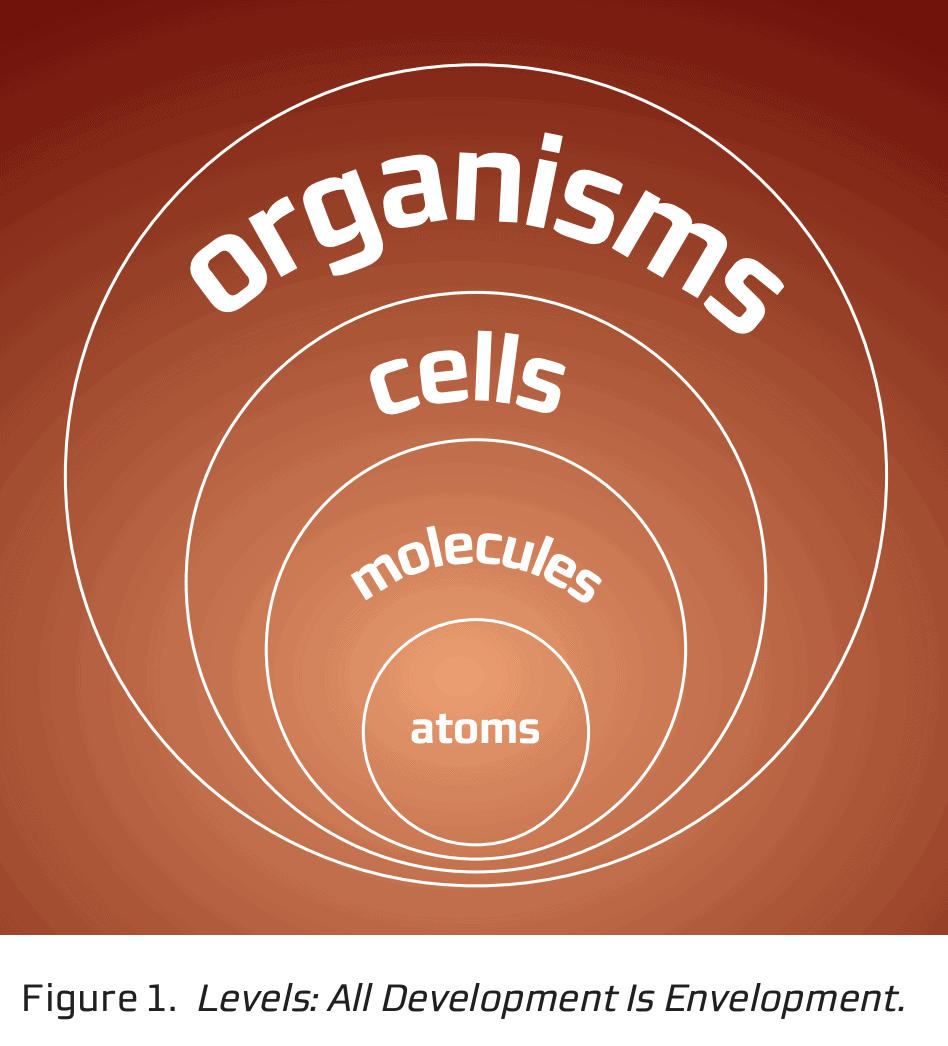
Example: A whole atom is part of a whole molecule, and the whole molecule is part of a whole cell, and the whole cell is part of a whole organism, and so on (each of these entities is neither a whole nor a part, but a whole/part, a holon).
Horizontal & Vertical:
- Agency (horizontal capacity): Drive/tendency to maintain its own wholeness, identity, autonomy, agency (capacity to maintain its own wholeness in the face of environmental pressures which would otherwise obliterate it).
- Communion (horizontal capacity): Drive/tendency to fit in as a part of something else (its own existence depends upon its capacity to fit into its environment).
- Self-dissolution (vertical capacity): If a holon fails to maintain its agency and its communions, then it can break down completely and decompose into its subholons (tend to dissolve in the reverse direction that they were built up).
- Self-transcendence (vertical capacity): Evolution is a wildly self-transcending process (evolution is in part a process of transcendence, which incorporates what went before and then adds incredibly novel components).
Span & Depth:
- Span: The number of holons on any given level.
- Depth: The number of levels in any holarchy. The basic drive of evolution is to increase depth. The greater the depth of a holon, the greater its degree of consciousness (consciousness is simply what depth looks like from the inside, from within). As depth increases, consciousness increasingly awakens. The ultimate depth is an ultimate oneness with the All, but this realization is not given equally to all beings even though all beings are equally manifestations of Spirit. This realization is the result of a developmental and evolutionary process of growth and transcendence.
- Greater depth, less span: Each successive level of evolution produces greater depth and less span. Because the higher transcends and includes the lower, there will always be less of the higher and more of the lower (no exceptions).
Value:
- Every holon has equal Ground value: All holons, from atoms to apes, are perfect manifestations of Emptiness or Spirit, with no higher or lower, better or worse. Spirit is both the highest level in the holarchy (which transcends all, includes all), and the equally present Ground of each level. It is both the Goal and the Ground of the entire sequence.
- Every holon has intrinsic value (or the value of its own particular wholeness/depth): The greater the wholeness/depth, then the greater the intrinsic value. Even though an ape and an atom are both perfect expressions of Spirit (they both have equal Ground value), the ape has more depth/wholeness, and therefore more intrinsic value.
- Every holon has extrinsic value (or instrumental value, value for other holons): Every holon is not only a whole, it is also a part. And as a part, it has value for others (it is part of a whole upon which other holons depend for their existence). The more it is a part, the more extrinsic value it has. An atom has more extrinsic value than an ape (destroy all apes, and not too much of the universe is affected; destroy all atoms, and everything but subatomic particles is destroyed). Each holon is also a part of some other whole(s), and as a part, it has responsibilities to the maintenance of that whole. Responsibilities are simply a description of the conditions that any holon must meet in order to be a part of the whole. Responsibilities express the conditions for the extrinsic value of a holon to exist, the conditions necessary to sustain its partness/communion/span.
Emergence & Evolution:
- Holons emerge holarchically & holarchies co-evolve: We live in a universe of creative emergence. Out of Emptiness, holons creatively emerge. The only way you get a holism is via a holarchy. All evolutionary and developmental patterns proceed by holarchization, by a process of increasing orders of wholeness and inclusion, which is a type of ranking by holistic capacity. This is why the basic principle of holism is holarchy: the higher or deeper dimension provides a principle, or a ‘glue,’ or a pattern, that unites and links otherwise separate and conflicting and isolated parts into a coherent unity. The micro is in relational exchange with the macro at all levels of its depth.
- Each emergent holon transcends but includes its predecessor(s), and evolution always goes beyond what went before: Since all holons are whole/parts, the wholeness transcends (in that it has certain emergent or novel or creative properties that are not merely the sum of its components), but the parts are included (because the junior holons are nonetheless components of the new holon). Each emergence is a decentering, a transcendence. It is always struggling to establish new limits, and then struggling just as hard to break them, to transcend them, to move beyond them into more encompassing and integrative and holistic modes.
- The lower sets the possibilities of the higher; the higher sets the probabilities of the lower: The lower the level of organization of a holon, the more fundamental it is. Lower holons are necessary (but not sufficient) ingredients of higher holons. The higher the level of organization of a holon, the more significant it is (giving meaning and significance to the lower levels). Each higher level of holons has emergent qualities that cannot be derived from (nor totally reduced to) its lower levels.
- Evolution has directionality: Increasing complexity, increasing differentiation/integration, increasing organization/structuration, increasing relative autonomy, increasing telos. Because evolution goes beyond what went before, but because it must embrace what went before, then its very nature is to transcend and include, and thus it has an inherent directionality, a secret impulse, toward increasing depth, increasing intrinsic value, increasing consciousness.
- Evolution is best thought of as Spirit-in-action (or God-in-the-making): Spirit unfolds itself at every stage of development, thus manifesting more of itself, and realizing more of itself, at every unfolding. Spirit is not some particular stage, or some favorite ideology, or some specific god or goddess, but rather the entire process of unfolding itself, an infinite process that is completely present at every finite stage, but becomes more available to itself with every evolutionary opening.
Key Concept: Evolution is always ‘transcend & include’ (or ‘unfold & enfold’, ‘development is envelopment’)
Growth/nested hierarchies: Each higher level ‘transcends and includes’ its predecessors (incorporates and goes beyond). The notion of ‘development is envelopment’ allows us to recognize nested truths.
Transcend: Means that we are going beyond the present stage to add a new and larger stage or to add new and novel material to our awareness, and we need to own that material responsibly—we need to include it fully in our awareness.
Include: As each new level unfolds, it enfolds its predecessor. It includes or embraces it in its own makeup. Each level becomes more inclusive, more embracing, more integral—and less marginalizing, less exclusionary, less oppressive.
Not vice versa: Wholes depend upon parts, but not vice versa. Destroy any holon, and you will destroy all of the holons above it and none of the holons below it. The relation between levels is hierarchical, with each senior level transcending and including its juniors, but not vice versa (molecules contain atoms, but not vice versa; cells contain molecules, but not vice versa), and that ‘not vice versa’ establishes an asymmetrical hierarchy of increasing holistic capacity (which simply means that the senior dimension embraces the junior, but not vice versa, so that the senior is more holistic and encompassing).
You May Also Enjoy: