This is a book summary of The Psychology of Money: Timeless Lessons on Wealth, Greed, and Happiness by Morgan Housel.
I couldn’t ignore The Psychology of Money any longer. It seems like everyone is talking about it in my little corner of Twitter. Many are calling it their top book of the year. And, Amazon supports the hype.
If you’re looking for an intro to Morgan Housel, here you go:
Quick Housekeeping:
- All quotes are from the author, Morgan Housel, unless otherwise stated.
- I’ve added my own emphasis in bold.
Book Summary Contents:
- No One’s Crazy
- Luck & Risk
- Never Enough
- Confounding Compounding
- Getting Wealthy vs. Staying Wealthy
- Tails, You Win
- Freedom
- Man in the Car Paradox
- Wealth is What You Don’t See
- Save Money
- Reasonable > Rational
- Surprise!
- Room for Error
- You’ll Change
- Nothing’s Free
- You & Me
- The Seduction of Pessimism
- When You’ll Believe Anything
18 Wealth Lessons from The Psychology of Money by Morgan Housel (Book Summary + Infographic)
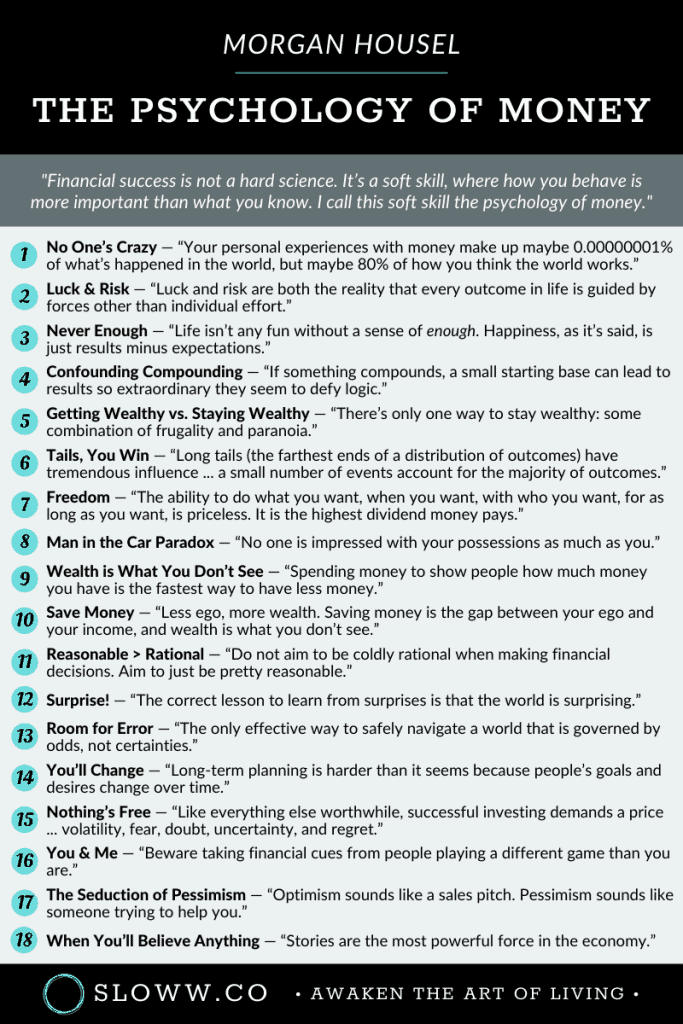
Overview of The Psychology of Money:
“The premise of this book is that doing well with money has a little to do with how smart you are and a lot to do with how you behave.”
- “Financial success is not a hard science. It’s a soft skill, where how you behave is more important than what you know. I call this soft skill the psychology of money.”
- “The aim of this book is to use short stories to convince you that soft skills are more important than the technical side of money.”
- “Physics isn’t controversial. It’s guided by laws. Finance is different. It’s guided by people’s behaviors.“
1. No One’s Crazy
“Your personal experiences with money make up maybe 0.00000001% of what’s happened in the world, but maybe 80% of how you think the world works.”
- “Every decision people make with money is justified by taking the information they have at the moment and plugging it into their unique mental model of how the world works.”
- “People do some crazy things with money. But no one is crazy. Here’s the thing: People from different generations, raised by different parents who earned different incomes and held different values, in different parts of the world, born into different economies, experiencing different job markets with different incentives and different degrees of luck, learn very different lessons.”
- “In theory people should make investment decisions based on their goals and the characteristics of the investment options available to them at the time. But that’s not what people do. The economists found that people’s lifetime investment decisions are heavily anchored to the experiences those investors had in their own generation—especially experiences early in their adult life.”
2. Luck & Risk
“Luck and risk are both the reality that every outcome in life is guided by forces other than individual effort. They are so similar that you can’t believe in one without equally respecting the other. They both happen because the world is too complex to allow 100% of your actions to dictate 100% of your outcomes.”
- “They are driven by the same thing: You are one person in a game with seven billion other people and infinite moving parts. The accidental impact of actions outside of your control can be more consequential than the ones you consciously take.“
- “The line between ‘inspiringly bold’ and ‘foolishly reckless’ can be a millimeter thick and only visible with hindsight. Risk and luck are doppelgangers.”
- “Be careful who you praise and admire. Be careful who you look down upon and wish to avoid becoming. Or, just be careful when assuming that 100% of outcomes can be attributed to effort and decisions.”
3. Never Enough
“Life isn’t any fun without a sense of enough. Happiness, as it’s said, is just results minus expectations.”
- “‘Enough’ is not too little … ‘Enough’ is realizing that the opposite—an insatiable appetite for more—will push you to the point of regret.”
- “The hardest financial skill is getting the goalpost to stop moving. But it’s one of the most important. If expectations rise with results there is no logic in striving for more because you’ll feel the same after putting in extra effort. It gets dangerous when the taste of having more—more money, more power, more prestige—increases ambition faster than satisfaction.”
- “Maintaining a lifestyle below what you can afford is avoiding the psychological treadmill of keeping up with the Joneses.”
4. Confounding Compounding
“If something compounds—if a little growth serves as the fuel for future growth—a small starting base can lead to results so extraordinary they seem to defy logic. It can be so logic-defying that you underestimate what’s possible, where growth comes from, and what it can lead to.”
- “$81.5 billion of Warren Buffett’s $84.5 billion net worth came after his 65th birthday. Our minds are not built to handle such absurdities.”
- “If you want to do better as an investor, the single most powerful thing you can do is increase your time horizon. Time is the most powerful force in investing.”
- “Good investing isn’t necessarily about earning the highest returns, because the highest returns tend to be one-off hits that can’t be repeated. It’s about earning pretty good returns that you can stick with and which can be repeated for the longest period of time. That’s when compounding runs wild.”
5. Getting Wealthy vs. Staying Wealthy
“There are a million ways to get wealthy … but there’s only one way to stay wealthy: some combination of frugality and paranoia.”
- “Getting money requires taking risks, being optimistic, and putting yourself out there. But keeping money requires the opposite of taking risk. It requires humility, and fear that what you’ve made can be taken away from you just as fast. It requires frugality and an acceptance that at least some of what you’ve made is attributable to luck, so past success can’t be relied upon to repeat indefinitely.”
- “The ability to stick around for a long time, without wiping out or being forced to give up, is what makes the biggest difference. This should be the cornerstone of your strategy, whether it’s in investing or your career or a business you own. There are two reasons why a survival mentality is so key with money. One is the obvious: few gains are so great that they’re worth wiping yourself out over. The other is the counterintuitive math of compounding. Compounding only works if you can give an asset years and years to grow.”
- “More than I want big returns, I want to be financially unbreakable. And if I’m unbreakable I actually think I’ll get the biggest returns, because I’ll be able to stick around long enough for compounding to work wonders.”
6. Tails, You Win
“A lot of things in business and investing work this way. Long tails—the farthest ends of a distribution of outcomes—have tremendous influence in finance, where a small number of events can account for the majority of outcomes.“
- “That can be hard to deal with, even if you understand the math. It is not intuitive that an investor can be wrong half the time and still make a fortune. It means we underestimate how normal it is for a lot of things to fail. Which causes us to overreact when they do.”
- “Anything that is huge, profitable, famous, or influential is the result of a tail event—an outlying one-in-thousands or millions event. And most of our attention goes to things that are huge, profitable, famous, or influential. When most of what we pay attention to is the result of a tail, it’s easy to underestimate how rare and powerful they are.”
- “A good definition of an investing genius is the man or woman who can do the average thing when all those around them are going crazy. Tails drive everything.“
7. Freedom
“The ability to do what you want, when you want, with who you want, for as long as you want, is priceless. It is the highest dividend money pays.“
- “The highest form of wealth is the ability to wake up every morning and say, ‘I can do whatever I want today.’ People want to become wealthier to make them happier. Happiness is a complicated subject because everyone’s different. But if there’s a common denominator in happiness—a universal fuel of joy—it’s that people want to control their lives.”
- “More than your salary. More than the size of your house. More than the prestige of your job. Control over doing what you want, when you want to, with the people you want to, is the broadest lifestyle variable that makes people happy.“
- “Money’s greatest intrinsic value—and this can’t be overstated—is its ability to give you control over your time. To obtain, bit by bit, a level of independence and autonomy that comes from unspent assets that give you greater control over what you can do and when you can do it.”
8. Man in the Car Paradox
“No one is impressed with your possessions as much as you are.”
- “There is a paradox here: people tend to want wealth to signal to others that they should be liked and admired. But in reality those other people often bypass admiring you, not because they don’t think wealth is admirable, but because they use your wealth as a benchmark for their own desire to be liked and admired.“
- “It’s a subtle recognition that people generally aspire to be respected and admired by others, and using money to buy fancy things may bring less of it than you imagine. If respect and admiration are your goal, be careful how you seek it. Humility, kindness, and empathy will bring you more respect than horsepower ever will.“
9. Wealth is What You Don’t See
“Spending money to show people how much money you have is the fastest way to have less money.”
- “The only way to be wealthy is to not spend the money that you do have. It’s not just the only way to accumulate wealth; it’s the very definition of wealth. We should be careful to define the difference between wealthy and rich. It is more than semantics. Not knowing the difference is a source of countless poor money decisions.”
- “Rich is a current income. Someone driving a $100,000 car is almost certainly rich, because even if they purchased the car with debt you need a certain level of income to afford the monthly payment. Same with those who live in big homes. It’s not hard to spot rich people. They often go out of their way to make themselves known.”
- “Wealth is hidden. It’s income not spent. Wealth is an option not yet taken to buy something later. Its value lies in offering you options, flexibility, and growth to one day purchase more stuff than you could right now.”
10. Save Money
“Building wealth has little to do with your income or investment returns, and lots to do with your savings rate.”
- “Independence, at any income level, is driven by your savings rate.” (Note: See FIRE (Financial Independence Retire Early))
- “Personal savings and frugality—finance’s conservation and efficiency—are parts of the money equation that are more in your control and have a 100% chance of being as effective in the future as they are today.”
- “Wealth is just the accumulated leftovers after you spend what you take in. And since you can build wealth without a high income, but have no chance of building wealth without a high savings rate, it’s clear which one matters more.”
11. Reasonable > Rational
“Do not aim to be coldly rational when making financial decisions. Aim to just be pretty reasonable. Reasonable is more realistic and you have a better chance of sticking with it for the long run, which is what matters most when managing money.”
- “What’s often overlooked in finance is that something can be technically true but contextually nonsense.”
- “A rational investor makes decisions based on numeric facts. A reasonable investor makes them in a conference room surrounded by co-workers you want to think highly of you, with a spouse you don’t want to let down, or judged against the silly but realistic competitors that are your brother-in-law, your neighbor, and your own personal doubts. Investing has a social component that’s often ignored when viewed through a strictly financial lens.“
12. Surprise!
“The correct lesson to learn from surprises is that the world is surprising. Not that we should use past surprises as a guide to future boundaries; that we should use past surprises as an admission that we have no idea what might happen next.”
- “History is the study of change, ironically used as a map of the future.”
- “It is smart to have a deep appreciation for economic and investing history. History helps us calibrate our expectations, study where people tend to go wrong, and offers a rough guide of what tends to work. But it is not, in any way, a map of the future.“
- “The most important economic events of the future—things that will move the needle the most—are things that history gives us little to no guide about. They will be unprecedented events. Their unprecedented nature means we won’t be prepared for them, which is part of what makes them so impactful. This is true for both scary events like recessions and wars, and great events like innovation.”
13. Room for Error
“Margin of safety—you can also call it room for error or redundancy—is the only effective way to safely navigate a world that is governed by odds, not certainties. And almost everything related to money exists in that kind of world.”
- “Worship room for error. A gap between what could happen in the future and what you need to happen in the future in order to do well is what gives you endurance, and endurance is what makes compounding magic over time.”
- “There is never a moment when you’re so right that you can bet every chip in front of you. The world isn’t that kind to anyone—not consistently, anyways. You have to give yourself room for error. You have to plan on your plan not going according to plan.“
- “History is littered with good ideas taken too far, which are indistinguishable from bad ideas. The wisdom in having room for error is acknowledging that uncertainty, randomness, and chance—’unknowns’—are an ever-present part of life. The only way to deal with them is by increasing the gap between what you think will happen and what can happen while still leaving you capable of fighting another day.”
14. You’ll Change
“Long-term planning is harder than it seems because people’s goals and desires change over time.”
- “An underpinning of psychology is that people are poor forecasters of their future selves. Imagining a goal is easy and fun. Imagining a goal in the context of the realistic life stresses that grow with competitive pursuits is something entirely different. This has a big impact on our ability to plan for future financial goals.”
- “The End of History Illusion is what psychologists call the tendency for people to be keenly aware of how much they’ve changed in the past, but to underestimate how much their personalities, desires, and goals are likely to change in the future.”
- “We should also come to accept the reality of changing our minds.”
15. Nothing’s Free
“Everything has a price, but not all prices appear on labels.”
- “Everything has a price, and the key to a lot of things with money is just figuring out what that price is and being willing to pay it. The problem is that the price of a lot of things is not obvious until you’ve experienced them firsthand, when the bill is overdue.”
- “Like everything else worthwhile, successful investing demands a price. But its currency is not dollars and cents. It’s volatility, fear, doubt, uncertainty, and regret—all of which are easy to overlook until you’re dealing with them in real time.”
- “Market returns are never free and never will be. They demand you pay a price, like any other product.”
16. You & Me
“Beware taking financial cues from people playing a different game than you are.”
- “An idea exists in finance that seems innocent but has done incalculable damage. It’s the notion that assets have one rational price in a world where investors have different goals and time horizons.”
- “It’s hard to grasp that other investors have different goals than we do, because an anchor of psychology is not realizing that rational people can see the world through a different lens than your own. Rising prices persuade all investors in ways the best marketers envy. They are a drug that can turn value-conscious investors into dewy-eyed optimists, detached from their own reality by the actions of someone playing a different game than they are.”
- “A takeaway here is that few things matter more with money than understanding your own time horizon and not being persuaded by the actions and behaviors of people playing different games than you are. The main thing I can recommend is going out of your way to identify what game you’re playing.”
17. The Seduction of Pessimism
“Optimism sounds like a sales pitch. Pessimism sounds like someone trying to help you.”
- “Pessimists often extrapolate present trends without accounting for how markets adapt.”
- “Progress happens too slowly to notice, but setbacks happen too quickly to ignore.”
- “It’s easier to create a narrative around pessimism because the story pieces tend to be fresher and more recent. Optimistic narratives require looking at a long stretch of history and developments, which people tend to forget and take more effort to piece together.”
18. When You’ll Believe Anything
“Stories are, by far, the most powerful force in the economy. They are the fuel that can let the tangible parts of the economy work, or the brake that holds our capabilities back.”
- “The more you want something to be true, the more likely you are to believe a story that overestimates the odds of it being true.”
- “An appealing fiction happens when you are smart, you want to find solutions, but face a combination of limited control and high stakes. They are extremely powerful. They can make you believe just about anything.”
- “Wanting to believe that we are in control is an emotional itch that needs to be scratched, rather than an analytical problem to be calculated and solved. The illusion of control is more persuasive than the reality of uncertainty. So we cling to stories about outcomes being in our control.“
You May Also Enjoy:
- Top book summaries (or browse all book summaries)