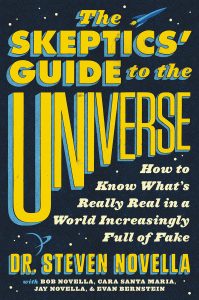
This is a book summary of The Skeptics’ Guide to the Universe: How to Know What’s Really Real in a World Increasingly Full of Fake by Dr. Steven Novella (Amazon).
For a visual intro to The Skeptics’ Guide to the Universe, check out:
Quick Housekeeping:
- All content in quotation marks is from the author unless otherwise stated.
- All content is organized into my own themes (not the author’s chapters).
- Emphasis has been added in bold for readability/skimmability.
Book Summary Contents: Click a link here to jump to a section below

25 Skeptic Concepts from The Skeptics’ Guide to the Universe by Steven Novella (Book Summary)
About the book The Skeptics’ Guide to the Universe
“This book is meant to be one giant inoculation against bad science, deception, and faulty thinking.”
- “Ultimately this is a journey of self-discovery, and hopefully this book will serve as a guide on that journey. In these pages you will learn about the many ways in which your brain fails, its tendency to prefer nice clean and reassuring stories, the absolute mess that is your memory, and all the preprogrammed biases in your thinking.”
- “You will also learn about the many ways in which society fails, the imperfections in the institutions of science, learning, and journalism. It’s intimidating to realize that we live in a world overflowing with misinformation, bias, myths, deception, and flawed knowledge.”
- “The skeptical, critical thinking, and scientific principles outlined in this book are like the rungs of a long ladder that humanity has used to climb laboriously out of the swamp of superstition, bias, hubris, and magical belief. We tend to look back now at medieval beliefs and congratulate ourselves for being born in a later age. But not every individual or even every institution has followed our best thinkers out of the muck. We all need to climb the ladder for ourselves.”
The book is organized into three main categories:
- Neuropsychological Humility: “This category includes knowledge of all the ways in which your brain function is limited or flawed … Before hypothesizing about spirits, new forces, or supernatural abilities, consider that—just maybe—your brain (like the brain of every other human on the planet) has some quirks and foibles. That is the meaning of neuropsychological humility.”
- Metacognition: “The second category of skeptical ‘gear’ is called metacognition—thinking about thinking. Metacognition is an exploration of all the ways in which your thinking is biased … Part of skeptical philosophy, metacognition, and critical thinking is the recognition that we all suffer from powerful and subtle cognitive biases. We have to both recognize them and make a conscious effort to work against them, realizing that this is an endless process. Part of the way to do this is to systematically doubt ourselves.”
- Science & Pseudoscience: “The third type of skeptical equipment has to do with science—how it works, the nature of pseudoscience and denialism, and how science can go wrong … All the pseudosciences we confront today have their roots in the past. The work of scientists and skeptics in previous decades can act like a vaccine, allowing us to mount a more rapid and robust response to fraud and quackery today.”
What is Scientific Skepticism?
“This is the essence of skepticism: How do we know what to believe and what to doubt?”
- “Scientific skepticism, a term first popularized by Carl Sagan, is an overall approach to knowledge that prefers beliefs and conclusions that are reliable and valid to ones that are comforting or convenient.”
- “Skepticism is largely a systematic effort in metacognition, which means understanding how we think and avoiding common mental pitfalls.”
- “Where scientific skepticism gets involved is when people make claims, have a pretense to knowledge, or state something as a fact or as if it’s a valid conclusion of logic or science.”
25 Skeptic Concepts from The Skeptics’ Guide to the Universe
1. Confabulation:
- “Put simply, we make shit up. This is a completely automatic and subconscious process. Again, our brains want to construct a continuous and consistent memory, so if there are any missing pieces it just makes them up to fill in the gaps.”
2. False Memory Syndrome:
- “The construction of entirely fake memories. This is accomplished through guided imagery, hypnosis, suggestion, and group pressure.”
3. Attentional/Inattentional Blindness:
- “We don’t see what we are not paying attention to, even if it happens right in front of our eyes.”
4. Baader-Meinhof Phenomenon:
- “Once you stumble upon an obscure word or fact, you encounter it again and again, seemingly against the odds. This is part simple coincidence but also part perception bias. You’ve likely encountered the word or fact before, but you just didn’t notice it.”
5. Hyperactive Agency Detection:
- “Hyperactive agency detection is the tendency to interpret events as if they were the deliberate intent of a conscious agent rather than the product of natural forces or unguided chaotic events.”
6. Dunning-Kruger Effect:
- “The Dunning-Kruger effect describes the inability to evaluate one’s own competency, leading to a general tendency to overestimate one’s abilities … The most competent individuals tend to underestimate their relative ability a little, but most people (the bottom 75 percent) increasingly overestimate their ability, and everyone thinks they’re above average.”
7. Hawthorne Effect (Observer Effect):
- “The Hawthorne or observer effect refers to the fact that simply observing something may alter its behavior, thereby creating an artifact that leads to an incorrect conclusion.”
8. Motivated Reasoning:
- “Motivated reasoning is the biased process we use to defend a position, ideology, or belief that we hold with emotional investment … We all have narratives by which we understand the world and our place in it. Some narratives are critical to our sense of identity. Preferred narratives support our worldview, our membership in a group, or our self-perception as a good and valuable person. We have narratives and beliefs that serve our basic psychological needs, such as the need for a sense of control. When those beliefs are challenged, we don’t take a rational and detached approach. We dig in our heels and engage in what is called motivated reasoning. We defend the core beliefs at all costs, shredding logic, discarding inconvenient facts, making up facts as necessary, cherry-picking only the facts we like, engaging in magical thinking, and using subjective judgments as necessary without any consideration for internal consistency. Collectively, these processes constitute motivated reasoning.”
9. Principle of Charity:
- “Give the other the benefit of the doubt—take the best interpretation of their position possible and deconstruct that.”
10. Tautology (Begging the Question):
- “An argument that utilizes circular reasoning, which means that the conclusion is also its own premise. The structure of such arguments is A = B therefore A = B, although the premise and conclusion might be formulated differently so the tautology is not immediately apparent … This fallacy is often called ‘begging the question,’ meaning that the premise assumes the conclusion, or that an argument assumes its initial point.”
11. Confusing Correlation with Causation:
- “Often used to give a statistical correlation a causal interpretation … In essence there are always four possible interpretations of any apparent correlation. The first is that the correlation is not causal at all. The second is that A causes B. The third is that B causes A. The fourth is that A and B are both caused by another variable, C. It’s helpful to go through all such possibilities before concluding that any one causal pattern is true.”
12. Argument from Authority:
- “Often this argument is implied by emphasizing the many years of experience of the individual making a specific claim, or the number of formal degrees they hold … Any time you rely on the source of an argument or position rather than facts and logic, that may become an argument from authority.”
13. Naturalistic Fallacy & Appeal to Nature:
- Naturalistic Fallacy: “The is/ought problem, confusing what is true with what ought to be true. This is not to be confused with the appeal-to-nature fallacy, which posits that being natural is in itself a virtue and anything natural is inherently superior to anything artificial.”
- Appeal to Nature: “The appeal to nature is a logical fallacy based upon the unwarranted assumption that things that are natural are inherently superior to things that are manufactured. Additionally, it relies upon a vague definition of ‘natural’ … It is distinct from the naturalistic fallacy, which refers mainly to the idea that whatever is in nature ought to be (the ‘is/ought’ problem) as outlined by David Hume … The appeal-to-nature fallacy is related to the naturalistic fallacy as a special case—some things that are good are natural, so all things natural must be good. The flip side of the appeal-to-nature coin is that anything that is ‘unnatural’ is inherently tainted to some degree.”
14. No True Scotsman:
- “The argument is made that all Scotsmen are brave, and when a counterexample of a cowardly Scotsman is provided, the original claim is defended by saying, ‘Well then, he’s no true Scotsman.’ In essence this fallacy consists of making an argument true by arbitrarily altering the definition of a key term so that the argument is true by definition. It can therefore be considered a special case of the circular reasoning fallacy.”
15. Texas Sharpshooter Fallacy:
- “A target shooter claims that he can always hit the bull’s-eye. He aims at the side of a barn, shoots a hole in the wood, then goes up and draws a target around the hole he just made, giving himself a bull’s-eye. What this analogy refers to is when someone chooses the criteria for success or failure after they know the outcome. It becomes a form of post hoc reasoning, deciding that a certain piece of evidence is evidence for the conclusion you desire, but you decide that only after you know what the evidence is.”
16. Gambler’s Fallacy:
- “If you flip a fair coin heads five times in a row, most people will feel tails is now due. The bias is the thinking that past events influence future events, even when there is no causal connection. Since each coin flip is independent, it does not matter what happened before.”
17. Confirmation Bias:
- “Confirmation bias is the tendency of individuals to seek out or interpret new information as support for previously held notions or beliefs, even when such interpretations don’t hold up to statistical scrutiny … Confirmation bias is a tendency to notice, accept, and remember information that appears to support an existing belief and to ignore, distort, explain away, or forget information that seems to contradict an existing belief. This process works undetected in the background of our minds to create the powerful illusion that the facts support our beliefs.”
18. Framing Bias:
- “Your thinking about something can be dramatically affected simply by how it is presented to you.”
19. Hindsight Bias:
- “Once we know the outcome of a situation, that knowledge colors our interpretation of what happened and why. We tend to think that whatever happened was inevitable, destined to happen, even if it was a close call.”
20. Occam’s Razor:
- “The principle of Occam’s razor, attributed to William of Ockham (1287–1347), states that when two or more hypotheses are consistent with the available data, then the hypothesis that introduces the fewest new assumptions should be preferred. In the original Latin, ‘Non sunt multiplicanda entia sine necessitate,’ which translates to ‘Entities must not be multiplied without necessity’ … The direct quote from William of Ockham is this: ‘Numquam ponenda est pluralitas sine necessitate’ (Plurality must never be posited without necessity) … Stated another (and more accurate) way, Occam’s razor is the principle that the introduction of new assumptions should be minimized. ‘New assumptions’ shouldn’t be conflated with ‘additional explanations or diagnoses.’ That is the error.”
21. Availability Heuristic:
- “The unstated assumption that if we can easily call an example of something to mind, it must therefore be common or important.”
22. Anchoring Heuristic:
- “This one is also common in marketing. Let’s say I show you a house and then ask you if you think the house is worth more or less than $100,000. I then ask you what you think the house is worth. I ask another person if they think the same house is worth more or less than $500,000, and then I ask them to guess the price. The person who was ‘anchored’ to the $100,000 reference will guess significantly lower than the person who was anchored to the $500,000 price, even though they’re assessing the same house.”
23. Fundamental Attribution Error:
- “The fundamental attribution error (or correspondence bias) is a cognitive bias in which we ascribe other people’s actions to internal factors such as personality while rationalizing our own actions as being the result of external factors beyond our control … We’re quick to conclude we’re the victim of circumstance, and we tend to be acutely aware of external factors that influence our thoughts and behavior. For other people, however, we tend to assume they are driven predominantly by internal factors having to do with their disposition and qualities.”
24. Cold Reading (Mentalism):
- “Cold reading is a collection of mentalism techniques used to create the illusion of having gained specific knowledge about a target through supernatural means. The techniques involve use of vague statements, high-probability guesswork, and feeding back knowledge gained from the subject themselves, while the target makes connections to their own personal experience. Cold reading is used in stage magic for entertainment, but also by a wide variety of less honest practitioners to feign psychic or arcane abilities … Going from vague statements to specific examples when connecting a guess to yourself is a known psychological phenomenon. It was first described by the psychologist Bertram R. Forer in 1949 and is now known as the Forer effect, although it’s also often called the Barnum effect after the famous carnival showman.”
25. Moving Goalpost:
- “A method of denial that involves arbitrarily moving the criteria for ‘proof’ or acceptance out of range of whatever evidence currently exists. If new evidence comes to light meeting the prior criteria, the goalpost is pushed back further—keeping it out of range of this new evidence.”
You May Also Enjoy:
- “Super Thinking” by Gabriel Weinberg & Lauren McCann (Book Summary)
- “The Art of Thinking Clearly” by Rolf Dobelli (Book Summary)