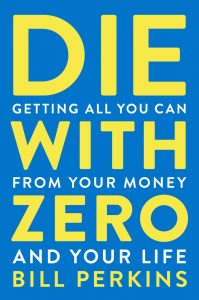
This is a book summary of Die With Zero: Getting All You Can from Your Money and Your Life by Bill Perkins (Amazon).
Here’s a video intro to Die With Zero and Bill Perkins:
Quick Housekeeping:
- All content in quotation marks is from the original author unless otherwise stated.
- I’ve added emphasis in bold for readability/skimmability.
Book Summary Contents: Click a link here to jump to a section below
- About the Book
- Rule 1: Maximize your positive life experiences
- Rule 2: Start investing in experiences early
- Rule 3: Aim to die with zero
- Rule 4: Use all available tools to help you die with zero
- Rule 5: Give money to your children or to charity when it has the most impact
- Rule 6: Don’t live your life on autopilot
- Rule 7: Think of your life as distinct seasons
- Rule 8: Know when to stop growing your wealth
- Rule 9: Take your biggest risks when you have little to lose

9 Money Rules for Living before Dying: “Die With Zero” by Bill Perkins (Book Summary)
About the book Die With Zero
“What’s the best way to spend your life energy before you die? This book is my answer to that question.”
- “We all have to survive, but we all want to do much more than survive: We want to really live. So that’s what I focus on in this book: thriving, not just surviving. This book is not about making your money grow—it’s about making your life grow.”
- “The premise of this book is that you should be focusing on maximizing your life enjoyment rather than on maximizing your wealth. Those are two very different goals. Money is just a means to an end: Having money helps you to achieve the more important goal of enjoying your life. But trying to maximize money actually gets in the way of achieving the more important goal.”
- “This entire book is predicated on the hard, cold truth that we will all die and, as we age, our health will gradually decline. But there’s another, less obvious truth about ‘dying’ that has important implications for how you should live your life: We all die a multitude of deaths throughout our lives.”
Rule 1: Maximize your positive life experiences
“Start actively thinking about the life experiences you’d like to have, and the number of times you’d like to have them. The experiences can be large or small, free or costly, charitable or hedonistic. But think about what you really want out of this life in terms of meaningful and memorable experiences.”
- “Everyone’s health generally declines with time, and sooner or later we all die, so the question we all must answer is how to make the most of our finite time on earth. Put that way, it sounds like a lofty, philosophical question—but that’s not how I see it. I’m trained as an engineer and made my fortune on the strength of my analytical skills, so I see this question as an optimization problem: how to maximize fulfillment while minimizing waste.”
- “What I am an advocate for is deciding what makes you happy and then converting your money into the experiences you choose.”
- “Maximizing your fulfillment from experiences—by planning how you will spend your time and money to achieve the biggest peaks you can with the resources you have—is how you maximize your life.”
Rule 2: Start investing in experiences early
“Remember that ‘early’ is right now. Of those experiences you thought about earlier, think about which ones would be appropriate to invest in today, this month, or this year. If you’re resisting having them now, consider the risk of not having them now. Think about the people you’d like to have experiences with—and picture the memory dividends you stand to gain from having those experiences sooner rather than later. Think about how you can actively enhance your memory dividends.”
- “The main idea here is that your life is the sum of your experiences. This just means that everything you do in life—all the daily, weekly, monthly, annual, and once-in-a-lifetime experiences you have—adds up to who you are. When you look back on your life, the richness of those experiences will determine your judgment of how full a life you’ve led.”
- “Here’s my investment advice in a nutshell: Invest in your life’s experiences—and start early, start early, start early.”
- “Experiences keep on giving in the form of fulfillment from your memories: Over time, the ongoing memory dividend can sometimes add up to more experience points than the original experience provided.”
Rule 3: Aim to die with zero
“If you’re still concerned and resisting the idea of dying with zero, try to figure out where this psychological resistance comes from. If you love your job, and you love going to work every day, identify ways that you can spend your money on activities that fit your work schedule.”
- “If you spend hours and hours of your life acquiring money and then die without spending all of that money, then you’ve needlessly wasted too many precious hours of your life. There is just no way to get those hours back.”
- “It makes perfect sense to want to die with zero. Not to reach zero before you die, which would leave you high and dry, but to have as little as possible left unused for all the time and energy you spent working to earn that money.”
- “People who save tend to save too much for too late in their lives. They are depriving themselves now just to care for a much, much older future self—a future self that may never live long enough to enjoy that money.”
Rule 4: Use all available tools to help you die with zero
“If you’re nervous about someday running out of money before you die, then spend some time looking to annuities as a possible solution.”
- “Remember that the goal is to eliminate as much waste as possible. How close you get to that goal depends on your own risk tolerance. If you have a very low tolerance for risk—meaning you will not accept even a tiny chance of outliving your money—you will either buy an annuity or you will self-insure by leaving a huge cushion.”
- “The part of that plan that I’ve been focusing on in this chapter is how to avoid running out of money—how not to outspend your savings. But of course that’s just one half of the question of how to die with zero; the other half is how not to waste your life energy by underspending.”
- “Dying with zero is not only about money: It’s also about time. Start thinking more about how you use your limited time, your life energy, and you’ll be well on your way to living the fullest life you possibly can.”
Rule 5: Give money to your children or to charity when it has the most impact
“Consider at what ages you want to give money to your children, and how much you want to give. The same goes with giving money to charity. Discuss these issues with your spouse or partner. And do it today! Be sure to consult on these matters with an expert such as an estate planner or a lawyer as well.”
- “Putting your kids first means you give to them much earlier, and you make a deliberate plan to make sure that what you have for your children reaches them when it will make the most impact. A real plan for dying with zero includes the kids, if you have kids. That way, you’ve already separated out their money (which becomes untouchable by you) from your money, which is what you must spend down to zero.”
- “When it comes to giving money to your kids, the optimal time is when they’re between 26 and 35—not too late to make a big impact and not so soon that they might squander the money. But what about giving money to charity? With charity, there’s no such thing as too soon.”
- “My number one rule is: Maximize your life experiences. So spend your money while you’re alive—whether it’s on yourself, your loved ones, or charity. And beyond that, find the optimal times to spend money.”
Rule 6: Don’t live your life on autopilot
“Think about your current physical health: What life experiences can you have now that you might not be able to have later? Think of one way in which you can invest your time or your money to improve your health and thereby improve all of your future life experiences. Learn about how to improve your eating habits to improve your health. Do more of the physical activities that you already enjoy (such as dancing or hiking) that will also improve your enjoyment of future experiences. If your ability to enjoy experiences is more constrained by time than by money or by health, think of one or two ways you can spend some money now to free up more of your time.”
- “The key takeaway is to strike the right balance between spending on the present (and only on what you value) and saving smartly for the future.“
- “If your capacity to enjoy life experiences is higher at some ages than others, then it makes sense to spend more of your money at certain ages than others!”
- “I’ve been talking about balancing the spending and saving you do throughout your life. I’ve already explained in general terms that you should shift spending to more or less the right ages. And you understand the three factors that most affect your ability to enjoy your life energy: health, free time, and money. But if your goal is to maximize lifetime enjoyment, that means finding out how much to spend each year, a number that varies depending on each person’s circumstances.”
Rule 7: Think of your life as distinct seasons
“If time-bucketing your whole life feels a bit overwhelming, just do the exercise with three time buckets covering the next 30 years. Know you can always add more to your list; just do it long before your age and health become a real factor. If you have children … What one experience do you want to have more of with them in the next year or two, before that phase of their life and your life is over?”
- “Time buckets are a simple tool for discovering what you want your life to look like in broad strokes. Here’s what I suggest you do. Draw a timeline of your life from now to the grave, then divide it into intervals of five or ten years. Each of those intervals—say, from age 30 to 40, or from 70 to 75—is a time bucket, which is just a random grouping of years. Then think about what key experiences—activities or events—you definitely want to have during your lifetime.”
- “This list is the opposite of the so-called bucket list, which is typically a single accounting of all the things you hope to do before you ‘kick the bucket,’ so to speak.”
- “By dividing goals into time buckets, you are taking a much more proactive approach to your life.”
Rule 8: Know when to stop growing your wealth
“Calculate your annual survival cost based on where you plan to live in retirement. Consult your doctor to get a read on your biological age and mortality; get all the objective tests you can afford that give you the status of your current health and eventual decline. Given your own health and history, think about when your enjoyment of those activities is likely to start declining in a noticeable way on an annual basis—and how the activities you love will be affected by this decline.”
- “Invest in experiences that yield long-lasting memories, always bear in mind that everyone’s health declines with age, give your money to your children before you die instead of saving for their inheritance, and learn to balance current enjoyment with later gratification.”
- “This is where my advice diverges from what most people do: You should find that one special point in your life when your net worth is the highest it will ever be. I call that point your net worth peak, or just ‘your peak.'”
- “Once you’ve finally determined your net worth peak, you must start spending down, or decumulating. This means you will be spending more in your real golden years, when you are in reasonably good shape in both health and wealth—between 45 and 60—than people usually do, because most people who save money for the future save for too late in life.”
Rule 9: Take your biggest risks when you have little to lose
“Identify opportunities that you’re not taking that pose little to risk to you. Always remember that you’re better off taking more chances when you are younger than when you’re older. Look at the fears that are holding you back, rational or irrational. Don’t let irrational fears get in the way of your dreams. Realize that at every moment you have a choice. The choices you make reflect your priorities, so be sure you’re making those choices deliberately.”
- “When you face asymmetric risk, it makes total sense to be bold, to grab the opportunity at hand. At the extreme, when the downside is very low (or nonexistent, as in the ‘nothing to lose’ case) and the upside is really high, it’s actually riskier not to make the bold move.”
- “By aiming to die with zero, you will forever change your autopilot focus from earning and saving and maximizing your wealth to living the best life you possibly can.”
- “In the end, the business of life is the acquisition of memories.”
You May Also Enjoy:
- See all book summaries