This is a book summary of Determined: A Science of Life without Free Will by Robert Sapolsky (Amazon).
Here’s a podcast intro to Robert Sapolsky and the book Determined:
Quick Housekeeping:
- All content in “quotation marks” is from the author (otherwise it’s paraphrased).
- All content is organized into my own themes (not the author’s chapters).
- Emphasis has been added in bold for readability/skimmability.
Book Summary Contents:
- About the Book
- One Seamless Thing
- Free Will & Intent
- Bad Luck & Good Luck
- Implications, Morals, & Justice
- Subtraction & Change
A Science of Life without Free Will: Determined by Robert Sapolsky (Book Summary)
About the book Determined
“This book has a goal—to get people to think differently about moral responsibility, blame and praise, and the notion of our being free agents. And to feel differently about those issues as well. And most of all, to change fundamental aspects of how we behave … My goal isn’t to convince you that there’s no free will; it will suffice if you merely conclude that there’s so much less free will than you thought that you have to change your thinking about some truly important things.”
- “The approach of this book is to show how determinism works, to explore how the biology over which you had no control, interacting with environment over which you had no control, made you you. And when people claim that there are causeless causes of your behavior that they call ‘free will,’ they have (a) failed to recognize or not learned about the determinism lurking beneath the surface and/or (b) erroneously concluded that the rarefied aspects of the universe that do work indeterministically can explain your character, morals, and behavior.”
- “The easy takeaway from the first half of this book is that the biological determinants of our behavior stretch widely over space and time—responding to events in front of you this instant but also to events on the other side of the planet or that shaped your ancestors centuries back. And those influences are deep and subterranean, and our ignorance of the shaping forces beneath the surface leads us to fill in the vacuum with stories of agency. Just to restate that irritatingly-familiar-by-now notion, we are nothing more or less than the sum of that which we could not control—our biology, our environments, their interactions. The most important message was that these are not all separate -ology fields producing behavior. They all merge into one—evolution produces genes marked by the epigenetics of early environment, which produce proteins that, facilitated by hormones in a particular context, work in the brain to produce you. A seamless continuum leaving no cracks between the disciplines into which to slip some free will.”
- “The theme of the second half of this book is this: We’ve done it before. Over and over, in various domains, we’ve shown that we can subtract out a belief that actions are freely, willfully chosen, as we’ve become more knowledgeable, more reflective, more modern. And the roof has not caved in; society can function without our believing that people with epilepsy are in cahoots with Satan and that mothers of people with schizophrenia caused the disease by hating their child.”
One Seamless Thing
“We are moths pulled to the flame of the most entrenched free-will myth … Yes, there are our attributes, gifts, shortcomings, and deficiencies over which we had no control, but it is us, we agentic, free, captain-of-our-own-fate selves who choose what we do with those attributes. Yes, you had no control over that ideal ratio of slow- to fast-twitch fibers in your leg muscles that made you a natural marathoner, but it’s you who fought through the pain at the finish line. Yes, you didn’t choose the versions of glutamate receptor genes you inherited that gave you a great memory, but you are responsible for being lazy and arrogant. Yes, you may have inherited genes that predispose you to alcoholism, but it’s you who commendably resists the temptation to drink.”
Not two different things:
“We’re usually pretty good at remembering that the biological stuff on the left is out of our control (see image below). And then on the right is the free will you supposedly exercise in choosing what you do with your biological attributes, the you who sits in a bunker in your brain but not of your brain. Your you-ness is made of nanochips, old vacuum tubes, ancient parchments with transcripts of Sunday-morning sermons, stalactites of your mother’s admonishing voice, streaks of brimstone, rivets made out of gumption. Whatever that real you is composed of, it sure ain’t squishy biological brain yuck. When viewed as evidence of free will, the right side of the chart is a compatibilist playground of blame and praise. It seems so hard, so counterintuitive, to think that willpower is made of neurons, neurotransmitters, receptors, and so on. There seems a much easier answer—willpower is what happens when that nonbiological essence of you is bespangled with fairy dust. And as one of the most important points of this book, we have as little control over the right side of the chart as over the left. Both sides are equally the outcome of uncontrollable biology interacting with uncontrollable environment.”
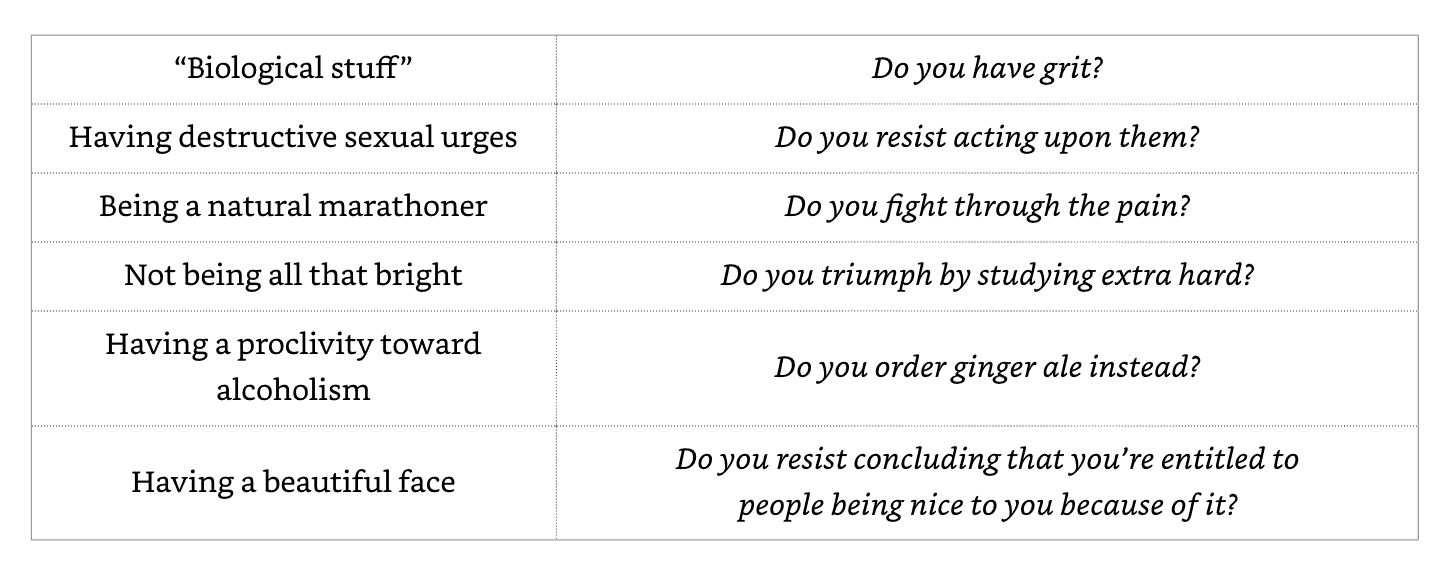
- “Look once again at the actions in the right column, those crossroads that test our mettle. Do you resist acting on your destructive sexual urges? Do you fight through the pain, work extra hard to overcome your weaknesses? You can see where this is heading: (a) grit, character, backbone, tenacity, strong moral compass, willing spirit winning out over weak flesh, are all produced by the prefontal cortex (PFC); (b) the PFC is made of biological stuff identical to the rest of your brain; (c) your current PFC is the outcome of all that uncontrollable biology interacting with all that uncontrollable environment … All sorts of things often out of your control—stress, pain, hunger, fatigue, whose sweat you’re smelling, who’s in your peripheral vision—can modulate how effectively your PFC does its job. Usually without your knowing it’s happening.”
- “We’re pretty good at recognizing that we have no control over the attributes that life has gifted or cursed us with. But what we do with those attributes at right/wrong crossroads powerfully, toxically invites us to conclude, with the strongest of intuitions, that we are seeing free will in action. But the reality is that whether you display admirable gumption, squander opportunity in a murk of self-indulgence, majestically stare down temptation or belly flop into it, these are all the outcome of the functioning of the PFC and the brain regions it connects to. And that PFC functioning is the outcome of the second before, minutes before, millennia before.”
- “It’s biological turtles all the way down with respect to all of who we are, not just some parts. It’s not the case that while our natural attributes and aptitudes are made of sciencey stuff, our character, resilience, and backbone come packaged in a soul. Everything is turtles all the way down, and when you come to a juncture where you must choose between the easy way and the harder but better way, your frontal cortex’s actions are the result of the exact same one-second-before-one-minute-before as everything else in your brain. It is the reason that, try as we might, we can’t will ourselves to have more willpower … It’s impossible to successfully wish what you’re going to wish for. It’s impossible to successfully will yourself to have more willpower. And that it isn’t a great idea to run the world on the belief that people can and should.”
It’s all seamless:
“The biological determinants of our behavior stretch widely over space and time—responding to events in front of you this instant but also to events on the other side of the planet or that shaped your ancestors centuries back. And those influences are deep and subterranean, and our ignorance of the shaping forces beneath the surface leads us to fill in the vacuum with stories of agency. Just to restate that irritatingly-familiar-by-now notion, we are nothing more or less than the sum of that which we could not control—our biology, our environments, their interactions. The most important message is that these are not all separate -ology fields producing behavior. They all merge into one—evolution produces genes marked by the epigenetics of early environment, which produce proteins that, facilitated by hormones in a particular context, work in the brain to produce you. A seamless continuum leaving no cracks between the disciplines into which to slip some free will.”
- “Talk about the evolution of the PFC, and you’re also talking about the genes that evolved, the proteins they code for in the brain, and how childhood altered the regulation of those genes and proteins. A seamless arc of influences bringing your PFC to this moment, without a crevice for free will to lodge in.”
- “If you talk about the effects of neurotransmitters on behavior, you are also implicitly talking about the genes that specify the construction of those chemical messengers, and the evolution of those genes—the fields of ‘neurochemistry,’ ‘genetics,’ and ‘evolutionary biology’ can’t be separated. If you examine how events in fetal life influence adult behavior, you are also automatically considering things like lifelong changes in patterns of hormone secretion or in gene regulation. If you discuss the effects of mothering style on a kid’s eventual adult behavior, by definition you are also automatically discussing the nature of the culture that the mother passes on through her actions. There’s not a single crack of daylight to shoehorn in free will … All these disciplines collectively negate free will because they are all interlinked, constituting the same ultimate body of knowledge.”
- “The biology/environment interactions of, say, a minute ago and a decade ago are not separate entities … Each moment flowing from all that came before. And whether it’s the smell of a room, what happened to you when you were a fetus, or what was up with your ancestors in the year 1500, all are things that you couldn’t control. A seamless stream of influences that precludes being able to shoehorn in this thing called free will that is supposedly in the brain but not of it.”
Free Will & Intent
“Why did that moment just occur? ‘Because of what came before it.’ Then why did that moment just occur? ‘Because of what came before that,’ forever, isn’t absurd and is, instead, how the universe works. The absurdity amid this seamlessness is to think that we have free will and that it exists because at some point, the state of the world (or of the frontal cortex or neuron or molecule of serotonin . . .) that ‘came before that’ happened out of thin air.”
Free Will & Free Won’t:
“I think that it is essential that we face our lack of free will.”
- “We have no free will at all.”
- “We are not captains of our ships; our ships never had captains … I obviously think that we should face the music about our uncaptained ships.”
- “Free won’t is just as suspect as free will, and for the same reasons. Inhibiting a behavior doesn’t have fancier neurobiological properties than activating a behavior, and brain circuitry even uses their components interchangeably. For example, sometimes brains do something by activating neuron X, sometimes by inhibiting the neuron that is inhibiting neuron X. Calling the former ‘free will’ and calling the latter ‘free won’t’ are equally untenable.”
What would it take for free will to exist?
“In order to prove there’s free will, you have to show that some behavior just happened out of thin air in the sense of considering all the biological precursors.”
- “Show me that the thing a neuron just did in someone’s brain was unaffected by any of these preceding factors—by the goings-on in the eighty billion neurons surrounding it, by any of the infinite number of combinations of hormone levels percolated that morning, by any of the countless types of childhoods and fetal environments were experienced, by any of the two to the four millionth power different genomes that neuron contains, multiplied by the nearly as large range of epigenetic orchestrations possible. Et cetera. All out of your control.”
- “Here’s the challenge to a free willer: Find me the neuron that started this process in this man’s brain, the neuron that had an action potential for no reason, where no neuron spoke to it just before. Then show me that this neuron’s actions were not influenced by whether the man was tired, hungry, stressed, or in pain at the time. That nothing about this neuron’s function was altered by the sights, sounds, smells, and so on, experienced by the man in the previous minutes, nor by the levels of any hormones marinating his brain in the previous hours to days, nor whether he had experienced a life-changing event in recent months or years. And show me that this neuron’s supposedly freely willed functioning wasn’t affected by the man’s genes, or by the lifelong changes in regulation of those genes caused by experiences during his childhood. Nor by levels of hormones he was exposed to as a fetus, when that brain was being constructed. Nor by the centuries of history and ecology that shaped the invention of the culture in which he was raised. Show me a neuron being a causeless cause in this total sense.”
- “The prominent compatibilist philosopher Alfred Mele of Florida State University emphatically feels that requiring something like that of free will is setting the bar ‘absurdly high.’ But this bar is neither absurd nor too high. Show me a neuron (or brain) whose generation of a behavior is independent of the sum of its biological past, and for the purposes of this book, you’ve demonstrated free will … It is anything but an absurdly high bar or straw man to say that free will can exist only if neurons’ actions are completely uninfluenced by all the uncontrollable factors that came before. It’s the only requirement there can be, because all that came before, with its varying flavors of uncontrollable luck, is what came to constitute you. This is how you became you.”
Intent:
“Where does intent come from? Yes, from biology interacting with environment one second before … But also from one minute before, one hour, one millennium—this book’s main song and dance … Where does intent come from? What makes us who we are at any given minute? What came before … To understand where your intent came from, all that needs to be known is what happened to you in the seconds to minutes before you formed the intention … As well as what happened to you in the hours to days before. And years to decades before. And during your adolescence, childhood, and fetal life. And what happened when the sperm and egg destined to become you merged, forming your genome. And what happened to your ancestors centuries ago when they were forming the culture you were raised in, and to your species millions of years ago. Yeah, all that.”
- “Intent features heavily in issues about moral responsibility: Did the person intend to act as she did? When exactly was the intent formed? Did she know that she could have done otherwise? Did she feel a sense of ownership of her intent? These are pivotal issues to philosophers, legal scholars, psychologists, and neurobiologists. In fact, a huge percentage of the research done concerning the free-will debate revolves around intent, often microscopically examining the role of intent in the seconds before a behavior happens … All this is ultimately irrelevant to deciding that there’s no free will. This is because this approach misses 99 percent of the story by not asking the key question: And where did that intent come from in the first place? This is so important because, as we will see, while it sure may seem at times that we are free to do as we intend, we are never free to intend what we intend. Maintaining belief in free will by failing to ask that question can be heartless and immoral and is as myopic as believing that all you need to know to assess a movie is to watch its final three minutes.”
- “The most fundamental question: Why did you form the intent that you did? You don’t ultimately control the intent you form. You wish to do something, intend to do it, and then successfully do so. But no matter how fervent, even desperate, you are, you can’t successfully wish to wish for a different intent. And you can’t meta your way out—you can’t successfully wish for the tools (say, more self-discipline) that will make you better at successfully wishing what you wish for … It doesn’t really matter when intent occurred. All that matters is how that intent came to be. We can’t successfully wish to not wish for what we wish for; we can’t announce that good and bad luck even out over time, since they’re far more likely to progressively diverge. Someone’s history can’t be ignored, because all we are is our history.”
- “The intent you form, the person you are, is the result of all the interactions between biology and environment that came before. All things out of your control. Each prior influence flows without a break from the effects of the influences before. As such, there’s no point in the sequence where you can insert a freedom of will that will be in that biological world but not of it.”
Bad Luck & Good Luck
“Our actions are the mere amoral outcome of biological luck for which we are not responsible … We are nothing more or less than the cumulative biological and environmental luck, over which we had no control, that has brought us to any moment … All that came before, with its varying flavors of uncontrollable luck, is what came to constitute you. This is how you became you … This seamless stream shows why bad luck doesn’t get evened out, why it amplifies instead.”
The Unlucky Ones:
“Have some particular unlucky gene variant, and you’ll be unluckily sensitive to the effects of adversity during childhood. Suffering from early-life adversity is a predictor that you’ll be spending the rest of your life in environments that present you with fewer opportunities than most, and that enhanced developmental sensitivity will unluckily make you less able to benefit from those rare opportunities—you may not understand them, may not recognize them as opportunities, may not have the tools to make use of them or to keep you from impulsively blowing the opportunity. Fewer of those benefits make for a more stressful adult life, which will change your brain into one that is unluckily bad at resilience, emotional control, reflection, cognition . . . Bad luck doesn’t get evened out by good. It is usually amplified until you’re not even on the playing field that needs to be leveled.”
- “Suppose you’re born a crack baby. In order to counterbalance this bad luck, does society rush in to ensure that you’ll be raised in relative affluence and with various therapies to overcome your neurodevelopmental problems? No, you are overwhelmingly likely to be born into poverty and stay there. Well then, says society, at least let’s make sure your mother is loving, is stable, has lots of free time to nurture you with books and museum visits. Yeah, right; as we know, your mother is likely to be drowning in the pathological consequences of her own miserable luck in life, with a good chance of leaving you neglected, abused, shuttled through foster homes. Well, does society at least mobilize then to counterbalance that additional bad luck, ensuring that you live in a safe neighborhood with excellent schools? Nope, your neighborhood is likely to be gang-riddled and your school underfunded.”
- “Having a neuropsychiatric disorder, having been born into a poor family, having the wrong face or skin color, having the wrong ovaries, loving the wrong gender. Not being smart enough, beautiful enough, successful enough, extroverted enough, lovable enough. Hatred, loathing, disappointment, the have-nots persuaded to believe that they deserve to be where they are because of the blemish on their face or their brain. All wrapped in the lie of a just world.”
- “You start out a marathon a few steps back from the rest of the pack in this world of ours … A quarter mile in, because you’re still lagging conspicuously at the back of the pack, it’s your ankles that some rogue hyena nips. At the five-mile mark, the rehydration tent is almost out of water and you can get only a few sips of the dregs. By ten miles, you’ve got stomach cramps from the bad water. By twenty miles, your way is blocked by the people who assume the race is done and are sweeping the street. And all the while, you watch the receding backsides of the rest of the runners, each thinking that they’ve earned, they’re entitled to, a decent shot at winning. Luck does not average out over time … instead our world virtually guarantees that bad and good luck are each amplified further.”
The Lucky Ones:
“Maybe you’re deflated by the realization that part of your success in life is due to the fact that your face has appealing features. Or that your praiseworthy self-discipline has much to do with how your cortex was constructed when you were a fetus. That someone loves you because of, say, how their oxytocin receptors work. That you and the other machines don’t have meaning. If these generate a malaise in you, it means one thing that trumps everything else—you are one of the lucky ones.”
- “You are privileged enough to have success in life that was not of your own doing, and to cloak yourself with myths of freely willed choices. Heck, it probably means that you’ve both found love and have clean running water. That your town wasn’t once a prosperous place where people manufactured things but is now filled with shuttered factories and no jobs, that you didn’t grow up in the sort of neighborhood where it was nearly impossible to ‘Just Say No’ to drugs because there were so few healthy things to say yes to, that your mother wasn’t working three jobs and barely making the rent when she was pregnant with you, that a pounding on the door isn’t from ICE. That when you encounter a stranger, their insula and amygdala don’t activate because you belong to an out-group. That when you are truly in need, you’re not ignored.”
- “If there’s no free will, you don’t deserve praise for your accomplishments, you haven’t earned or are entitled to anything. Dan Dennett feels this—not only will the streets be overrun with rapists and murderers if we junk free will, but in addition, ‘no one would deserve to receive the prize they competed for in good faith and won.’ Oh, that worry, that your prizes will feel empty. In my experience, it’s going to be plenty hard to convince people that a remorseless murderer doesn’t deserve blame. But that’s going to be dwarfed by the difficulty of convincing people that they themselves don’t deserve to be praised if they’ve helped that old woman cross the street.”
- “A lot of compatibilists are actually saying that there has to be free will because it would be a total downer otherwise, doing contortions to make an emotional stance seem like an intellectual one. Humans ‘descended from the apes! Let us hope it is not true, but if it is, let us pray that it will not become generally known,’ said the wife of an Anglican bishop in 1860, when told about Darwin’s novel theory of evolution. One hundred fifty-six years later, Stephen Cave titled a much-discussed June 2016 article in The Atlantic ‘There’s No Such Thing as Free Will . . . but We’re Better Off Believing in It Anyway.'”
Implications, Morals, & Justice
We have no free will at all. Here would be some of the logical implications of that being the case:
· Blame & Punishment: “That there can be no such thing as blame, and that punishment as retribution is indefensible—sure, keep dangerous people from damaging others, but do so as straightforwardly and nonjudgmentally as keeping a car with faulty brakes off the road.”
· Praise & Reward: “That it can be okay to praise someone or express gratitude toward them as an instrumental intervention, to make it likely that they will repeat that behavior in the future, or as an inspiration to others, but never because they deserve it. And that this applies to you when you’ve been smart or self-disciplined or kind.”
· Love & Hate: “That you recognize that the experience of love is made of the same building blocks that constitute wildebeests or asteroids. That no one has earned or is entitled to being treated better or worse than anyone else. And that it makes as little sense to hate someone as to hate a tornado because it supposedly decided to level your house, or to love a lilac because it supposedly decided to make a wonderful fragrance.”
Morals:
“There is no justifiable ‘deserve.’ The only possible moral conclusion is that you are no more entitled to have your needs and desires met than is any other human. That there is no human who is less worthy than you to have their well-being considered. You may think otherwise, because you can’t conceive of the threads of causality beneath the surface that made you you, because you have the luxury of deciding that effort and self-discipline aren’t made of biology, because you have surrounded yourself with people who think the same. But this is where the science has taken us. And we need to accept the absurdity of hating any person for anything they’ve done; ultimately, that hatred is sadder than hating the sky for storming, hating the earth when it quakes, hating a virus because it’s good at getting into lung cells. This is where the science has brought us as well.”
- “We know that every step higher in an Adverse Childhood Experience score increases the odds of adult antisocial behavior by about 35 percent; given that, we already know enough. We know that your life expectancy will vary by thirty years depending on the country you’re born in, twenty years depending on the American family into which you happen to be born; we already know enough. And we already know enough, because we understand that the biology of frontocortical function explains why at life’s junctures, some people consistently make the wrong decision. We already know enough to understand that the endless people whose lives are less fortunate than ours don’t implicitly ‘deserve’ to be invisible.”
- “I am put into a detached, professorial, eggheady sort of rage by the idea that you can assess someone’s behavior outside the context of what brought them to that moment of intent, that their history doesn’t matter. Or that even if a behavior seems determined, free will lurks wherever you’re not looking. And by the conclusion that righteous judgment of others is okay because while life is tough and we’re unfairly gifted or cursed with our attributes, what we freely choose to do with them is the measure of our worth. These stances have fueled profound amounts of undeserved pain and unearned entitlement … Everywhere you look, there’s that pain and self-loathing, staining all of life, about traits that are manifestations of biology.”
- “Not only does someone not deserve to be blamed or punished for having seizures but it is equally unjust and scientifically unjustifiable to make someone’s life a living hell because they drove despite not having taken their meds. Even if they did that because they didn’t want those meds interfering with their getting a buzz when drinking. But this is what we must do, if we are to live the consequences of what science is teaching us—that the brain that led someone to drive without their meds is the end product of all the things beyond their control from one second, one minute, one millennium before. And likewise if your brain has been sculpted into one that makes you kind or smart or motivated … It takes a certain kind of audacity and indifference to look at findings like these and still insist that how readily someone does the harder things in life justifies blame, punishment, praise, or reward.”
Punishment & Justice:
“There’s no such thing as free will, and blame and punishment are without any ethical justification. But we’ve evolved to find the right kind of punishment viscerally rewarding … If there’s no free will, there is no reform that can give retributive punishment even a whiff of moral good … ‘So you’re saying that violent criminals should just run wild with no responsibility for their actions?’ No. A car that, through no fault of its own, has brakes that don’t work should be kept off the road. A person with active COVID-19, through no fault of their own, should be blocked from attending a crowded concert. A leopard that would shred you, through no fault of its own, should be barred from your home.”
- “The approach that actually makes sense to me the most is the idea of ‘quarantine.’ It is intellectually clear as day and completely compatible with there being no free will … I really like quarantine models for reconciling there’s-no-free-will with protecting society from dangerous individuals. It seems like a logical and morally acceptable approach to take. Nonetheless, it has a doozy of a problem, one often framed narrowly as the issue of ‘victim’s rights.’ This is actually the tip of the iceberg of a gigantic problem that could sink any approach to subtracting free will out of dealing with dangerous individuals. This is the intense, complex, and often rewarding feelings we have about getting to punish someone.”
- “As outlined by the hard incompatibilist philosopher Derk Pereboom of Cornell University, it’s straight out of the medical quarantine model’s four tenets: (A) It is possible for someone to have a medical malady that makes them infectious, contagious, dangerous, or damaging to those around them. (B) It is not their fault. (C) To protect everyone else from them, as something akin to an act of collective self-defense, it is okay to harm them by constraining their freedom. (D) We should constrain the person the absolute minimal amount needed to protect everyone, and not an inch more … The extension of this to criminology in Pereboom’s thinking is obvious: (A) Some people are dangerous because of problems with the likes of impulse control, propensity for violence, or incapacity for empathy. (B) If you truly accept that there is no free will, it’s not their fault—it’s the result of their genes, fetal life, hormone levels, the usual. (C) Nonetheless, the public needs to be protected from them until they can be rehabilitated, if possible, justifying the constraint of their freedom. (D) But their ‘quarantine’ should be done in a way that constrains the least—do what’s needed to make them safe, and in all other ways, they’re free to be. The retributive justice system is built on backward-looking proportionality, where the more damage is caused, the more severe the punishment. A quarantine model of criminality shows forward-looking proportionality, where the more danger is posed in the future, the more constraints are needed.”
- “Pereboom’s quarantine model has been extended by philosopher Gregg Caruso of the State University of New York, another leading incompatibilist. Public health scientists don’t just figure out that, say, the brains of migrant farmworkers’ kids are damaged by pesticide residues. They also have a moral imperative to work to prevent that from happening in the first place (say, by testifying in lawsuits against pesticide manufacturers). Caruso extends this thinking to criminology—yes, the person is dangerous because of causes that they couldn’t control, and we don’t know how to rehabilitate them, so let’s minimally constrain them to keep everyone safe. But let’s also address the root causes, typically putting us in the realm of social justice. Just as public health workers think about the social determinants of health, a public health–oriented quarantine model that replaces the criminal justice system requires attention to the social determinants of criminal behavior. In effect, it implies that while a criminal can be dangerous, the poverty, bias, systemic disadvantaging, and so on that produce criminals are more dangerous.”
Subtraction & Change
“In the face of complicated things, our intuitions beg us to fill up what we don’t understand, even can never understand, with mistaken attributions … We desperately search for attribution … We seek attribution, we seek blame.”
Subtracting out free will:
“We can subtract responsibility out of our view of aspects of behavior. And this makes the world a better place.”
- “The multicentury arc of the changing perception of epilepsy is a model for what we have to do going forward. Once, having a seizure was steeped in the perception of agency, autonomy, and freely choosing to join Satan’s minions. Now we effortlessly accept that none of those terms make sense. And the sky hasn’t fallen. I believe that most of us would agree that the world is a better place because sufferers of this disease are not burned at the stake.”
- “Most people in the Westernized world have subtracted free will, responsibility, and blame out of their thinking about epilepsy. This is a stunning accomplishment, a triumph of civilization and modernity … We have managed to subtract out the notion of blame from the disease (and, in the process, become vastly more effective at treating the disease).”
- “We’ve done it before. Over and over, in various domains, we’ve shown that we can subtract out a belief that actions are freely, willfully chosen, as we’ve become more knowledgeable, more reflective, more modern. And the roof has not caved in; society can function without our believing that people with epilepsy are in cahoots with Satan and that mothers of people with schizophrenia caused the disease by hating their child.”
Change happens:
“We don’t change our minds. Our minds, which are the end products of all the biological moments that came before, are changed by circumstances around us … We don’t choose to change, but it is abundantly possible for us to be changed, including for the better.”
- “While change happens, we do not freely choose to change; instead, we are changed by the world around us, and one consequence of that is that we are also changed as to what sources of subsequent change we seek.”
- “Regardless of it seeming unimaginable, we can change in these realms. We have done this before, where we grew to recognize the true causes of something and, in the process, shed hate and blame and desire for retribution. Time after time, in fact. And not only has society not collapsed, but it has gotten better.”
- “Unless the process of discovery in science grinds to a halt tonight at midnight, the vacuum of ignorance that we try to fill with a sense of agency will just keep shrinking … Those in the future will marvel at what we didn’t yet know … They will view us as being as ignorant as we view the goitered peasants who thought Satan caused seizures. That borders on the inevitable. But it need not be inevitable that they also view us as heartless.”
You May Also Enjoy: