This is a book summary of Thought as a System by David Bohm (Amazon):
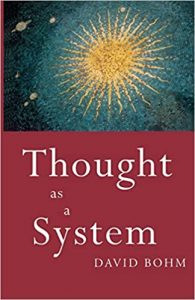
David Bohm’s “Thought as a System” should have the subtitle “The Scientist’s Guide to Spirituality”—it covers all the same things as a “spiritual book” yet never once mentions the word “spirituality.” Check it out if you want to get closer to the truth from a different angle.
The book is a slightly edited transcript from a series of seminars David Bohm gave in 1990 (he passed away in 1992, so this was some of his final thinking). Lucky for us, we can watch/listen all of these seminars (YouTube playlist).
Quick Housekeeping:
- All content in quotation marks is from the original author unless otherwise stated.
- All content is grouped into my own themes (not the author’s chapters).
- I’ve added emphasis in bold for readability/skimmability.
Book Summary Contents:
- The Thought System
- Flaw/Fault in the Thought System
- Incoherence & Coherence
- Necessity & Contingency
- Self-Image/Identity is Thought
- Conditioned & Unconditioned
- Awareness
- Insight & Truth

The Scientist’s Guide to Spirituality: Thought as a System by David Bohm (Book Summary)
The Thought System
“We’re not really aware of what is happening in this system which I’ve called ‘thought’. We don’t know how it works. We hardly know it is a system; it’s not part of our culture even to admit that it is a single system.”
What is a system?
- “A system is constantly engaged in a process of development, change, evolution and structure changes, and so forth, although there are certain features of the system which become relatively fixed. We call this the structure.”
- “That’s the whole idea of a system. It’s not necessarily closed, but it has a certain stability of structure. It tends to sustain and maintain its structure, so that when something from the outside comes in it reacts in such a way as to avoid basic change.”
- “We have some structure in thought as well—some relatively fixed features. Thought has been constantly evolving and we can’t say when that structure began. But with the growth of civilization it has developed a great deal.”
One system:
- “Thought is not merely the intellectual activity; rather it is one connected process which includes feeling and the body, and so on. Also, it passes between people—it’s all one process all over the world. I suggested that we call that process a ‘system’—a whole system in which every part is dependent on every other part.”
- “What I mean by ‘thought’ is the whole thing—it’s all one process. It is essential for me not to break that up, because it’s all one process; somebody else’s thoughts become my thoughts, and vice versa. Therefore it would be wrong and misleading to break it up into my thought, your thought, my feelings, these feelings, those feelings.”
- “Thought is a system. That system not only includes thoughts, ‘felts’ and feelings, but it includes the state of the body; it includes the whole of society—as thought is passing back and forth between people in a process by which thought evolved from ancient times.”
Thought and the body:
- “This distinction between thought and the physical is one where we should just draw a dotted line. But we have drawn a great big gulf between them in our thought. And therefore we perceive them that way.”
- “The thought process is neurophysiological as well as intellectual and emotional … Thus thought has, at the very least, a certain basis in this neurophysiological process; it can never be separated from it.”
- “I want to emphasize that it is not just psychological. Every reaction is also neurophysiological. That’s why I prefer to call it a reflex. Every reaction of thought is always simultaneously emotional, neurophysiological, chemical and everything else. It is all one system.”
Flaw/Fault in the Thought System
“We started out saying the trouble is that the world is in chaos, but I think we end up by saying that thought is in chaos. That’s each one of us. And that is the cause of the world being in chaos. Then the chaos of the world comes back and adds to the chaos of thought.”
Thought is the source of the trouble:
- “People have been dealing with this piecemeal—looking at symptoms, saying that we’ve got to solve this problem or that problem or that problem. But there is something deeper, which people haven’t been considering, that is constantly generating these problems. We can use the analogy of a stream, where people are pouring pollution upstream at the same time they are trying to remove it downstream. But as they remove it they may be adding more pollution of different kind.”
- “What is the source of all this trouble? I’m saying that the source is basically in thought. Many people would think that such a statement is crazy, because thought is the one thing we have with which to solve our problems. That’s part of our tradition. Yet it looks as if the thing we use to solve our problems is the source of our problems. It’s like going to the doctor and having him make you ill.”
- “The reason we don’t see the source of our problems is that the means by which we try to solve them are the source. That may seem strange to somebody who hears it for the first time, because our whole culture prides itself on thought as its highest achievement. I’m not suggesting that the achievements of thought are negligible; there are very great achievements in technology, in culture and in various other ways. But there is another side to it which is leading to our destruction, and we have to look at that.”
The flaw/fault:
- “This system has a fault in it—a systemic fault. It’s not a fault here, there or there, but it is a fault that is all throughout the system. Can you picture that? It’s everywhere and nowhere. You may say ‘I see a problem here, so I will bring my thought to bear on this problem’. But ‘my’ thought is part of the system. It has the same fault as the fault I’m trying to look at, or a similar fault.”
- “There is a kind of systemic flaw which is pervasive. So when we see something wrong with a part of this system, we bring another part to bear to try to correct it; but doing so will just add more, very similar troubles. We went on to say that it’s not possible to solve our problems that way—rather, they may get worse instead of better—and that these troubles throughout the world have been going on for thousands of years.”
- “All these problems … are the result of the way we’ve been thinking. But people don’t see that. They say, ‘We’re just thinking. Out there are the problems. The thinking is telling us about those problems—what they are.'”
Thought says it isn’t doing anything but telling you the way things are:
- “Thought is always doing a great deal, but it tends to say that it hasn’t done anything, that it is just telling you the way things are. But thought affects everything.”
- “When you are thinking something, you have the feeling that the thoughts do nothing except inform you the way things are and then you choose to do something and you do it. That’s what people generally assume. But actually, the way you think determines the way you’re going to do things. Then you don’t notice a result comes back, or you don’t see it as a result of what you’ve done, or even less do you see it as a result of how you were thinking.”
- “One of the key difficulties has always been that thought does something and then says that what it is doing is not thought. Thought creates a problem and then tries to do something about it while continuing to make the problem, because it doesn’t know what it is doing. It’s all a bunch of reflexes working.”
Thought runs itself without you doing anything:
- “We have the picture that there is ‘somebody’ inside us who is given all this information and then decides to have the intention to do something based on that. I’m suggesting that is not so.”
- “The general tacit assumption in thought is that it’s just telling you the way things are and that is not doing anything—that ‘you’ are inside there, deciding what to do with the information. But I want to say that you don’t decide what to do with the information. The information takes over. It runs you. Thought runs you.”
- “Thought gives the false information that you are running it, that you are the one who controls thought, whereas actually thought is the one which controls each one of us. Until thought is understood—better yet, more than understood, perceived—it will actually control us; but it will create the impression that it is our servant, that it is just doing what we want it to do. That’s the difficulty. Thought is participating and then saying it’s not participating. But it is taking part in everything.”
Thought is limited and incomplete but claims to know everything:
- “Thought is inherently going to be incomplete. It can at best provide an abstract representation, it will not contain the thing itself. The thing itself is not only more than could be contained in the representation; but additionally, thought is not always right. The thing itself is always in some way different from what we think it is. It is never exactly what we think.”
- “Thought is always trying to claim that it knows everything. It has that tendency in it, and we have to see why. This is a very dangerous tendency, which leads to self-deception. It doesn’t leave open the unknown. It doesn’t leave open that the thought is only a representation. And you must leave room in your thought for something more and something different. Healthy thought requires that it intrinsically be built so that it always has room for that.”
- “One of the ways thought goes wrong is that it claims, implicitly at least, to be able to know everything—that it could get rid of uncertainty and get rid of the unknown. There is this drive in thought to say that it will eventually get hold of everything.”
Thought affects perception and what you see:
- “Thought affects perceptions. You see or feel something produced by thought, but then the next thought comes along and says ‘I’m only telling you the way it is’. Thought makes that claim, while it is actually affecting the way things are. That mistake is crucial.”
- “This is the point I want to make: thought is affecting what you see. The representation enters into the perception. Sometimes you know something is a representation—such as when you draw a diagram or have a photograph. But in many subtle ways the representation enters directly into the perception, and you may miss the fact that it is coming from thought.”
- “Thought presents itself as separate from perception, as just telling you the way things are. Thought has this picture of how it works—that you see certain things and then thought merely tells you more about them; that it draws inferences, it does nothing and has no effect. Therefore that’s the way you see thought. But thought is actually doing more than that. It is affecting how you perceive everything.”
Incoherence & Coherence
“Thought doesn’t know it is doing something and then it struggles against what it is doing. It doesn’t want to know that it is doing it. And it struggles against the results, trying to avoid those unpleasant results while keeping on with that way of thinking. That is what I call sustained incoherence. There is also simple incoherence, which we can’t avoid having because thoughts are always incomplete.”
Incoherence:
- “The basic sign of incoherence is that you’re getting some result which you don’t intend and don’t want. And the other signs are contradiction, conflict, stress, confusion.”
- “The principal thing to notice is that your incoherent actions are reflexes. You are not doing them on purpose. You don’t know that you are doing them. It’s the same as the way your knee jerks when you hit it, whether you like it or not. Similarly, when something touches those reflex conditionings, you just jerk. It produces the result which you don’t want.”
- “The question is: are those reflexes coherent? According to the theory of evolution, incoherent systems don’t last very long. This is called ‘natural selection’. In thought, however, we seem to be able to keep up these incoherent systems of reflexes, at least quite a while. Sometimes the people who have them might not live very long, but in our society we have arranged conditions where we can go on with a lot of incoherence without actually leading to a selection process. The point is that reflexes can become incoherent and get stuck because of all these mechanisms.”
Coherence:
- “Coherence is sensed as harmony, order, beauty, goodness, truth, and all that everybody wants.”
- “The universe as a whole is coherent, and anything incoherent we do is just part of the coherence of the universe when we look at it that way, even though if we do something crazy we will get a result we don’t want.”
- “It is precisely because the universe is coherent that an incoherent species doesn’t survive.”
Necessity & Contingency
“We have to get straight on what is necessity and what is contingency. And in each situation this is what you’re doing all the time. You’re trying to assess the necessity and contingency.”
Necessity:
- “The whole idea of reality is bound together with the concept of necessity.”
- “The sense of necessity gives the greatest force and power there is in human affairs.”
- “The instinct of self-preservation is generally regarded as a very powerful set of reflexes built in by a set of genes, but the notion of absolute necessity will override that every time. You may say ‘my instinct is to preserve life’. But if the country says ‘it’s absolutely necessary to risk it’, then you have to risk it. Most people will feel that way. Or if you say ‘God demands it’, then the demands of God may override all the instincts. Or whatever it is. Your ambition may override the instincts, if it’s absolutely necessary to achieve your ambition. There’s a tremendous force in this. This notion of necessity is not merely intellectual. It involves everything.”
Contingency:
- “‘Contingency’ means ‘what can be otherwise’. If something can be otherwise, it’s meaningful to try to change it. If it cannot be otherwise, then there’s no use trying.”
- “Something that is necessary is a very powerful force which you can’t turn aside. Yet you may say ‘I have to turn it aside’. Thus we establish an order of necessity, saying ‘this turns aside for that, and this for that’. This notion of necessity is crucial to our whole ordering of thought; as is its opposite, which is contingency.”
- “The point is that the notion of necessity and contingency is always operating. Everybody is using it all the time without even thinking about doing so; it becomes part of our reflexes.”
Self-Image/Identity is Thought
“Now, it’s around the self-image that the problem is most difficult. We’ve got a kind of self-image that is almost like a television programme going on inside; its going on in the nerves, and so forth. And this image has several parts. One part seems to be ‘somebody’ inside at whom you are looking. Another part seems to be ‘somebody’ who is looking. We have different words for these.”
The role of society/culture:
- “Thought is a system belonging to the whole culture and society, evolving over history, and it creates the image of an individual who is supposed to be the source of thought. It gives the sense of an individual who is perceived and experienced, and so on. This would be conducive to the next step, which is for thought to claim that it only tells you the way things are and then the individual inside decides what to do with the information—he chooses. This is the picture which emerged gradually: thought tells you the way things are and then ‘you’ choose how to act from that information.”
- “The system gives you the identity. Without the system you would have no identity. The whole system of thought spread over the world is what gives you your identity, your place in the world and so forth. If there were no system, how could you sustain that identity? The identity could only exist socially and culturally. Although we may try to identify ourselves with God, or something like that, there again it’s the culture which gave you the thought allowing you to do that.”
- “We have the image that ‘I do the thinking’, ‘I am the thinker’. But in fact the culture has produced most of the thought. It sort of passes through me, I add a bit to it, I do this or that to it. The kind of thought we use, which is communicated, originates basically in the whole society and the culture. We have the sense of separation because our culture tells us that each individual is separate, and therefore we perceive it that way.”
Identity:
- “You get a sense of identity built up out of thought.”
- “We don’t need the notion of an identity, of an all-important identity on to which we are going to hold, because that gets in the way of the need to change our reflexes. Once we identify with something, our reflexes are that way—it’s very important, ‘necessary’. And we will want to preserve that identity even though it may involve ideas that are false.”
- “The identity has a certain limited significance. It’s not that we are going to dispose of it, but it has no fundamental deep eternal significance. There is eternal flow and movement that is creative. But this creativity can get caught up in a certain process.”
I (subject):
- “The system contains a reflex which produces the thought that it is ‘I’ who am doing everything. It has a very elaborate system of covering up what is happening.”
- “The word ‘I’ stands for the subject, the one who sees, who acts, who does, who determines everything, who has will … ‘I’ is the active agent. I will, I determine, I see, I choose, I think.”
- “The word ‘I’ by itself means almost the same as God. It’s the ultimate source of everything.”
Me (object):
- “Also there is ‘me’ to whom it’s all done.”
- “‘Me’ is the object, everything happens to me.”
Self:
- “Then, the ‘self’ is what unites those two. ‘I’ and ‘me’ are two sides of myself. So there are me, myself and I. That’s a concept of the self.”
- “The phrase ‘I am’ by itself represents the pure subject, the pure source, the one, the source of everything; and that ‘me’ represents the object. But we identify or equate ‘I am’ with ‘me’, saying ‘I am this, I am that, I am what I am, I am all the things attributed to me’. However, there comes a problem in equating ‘I am’ with ‘me’, because ‘me’ is always limited … Whereas ‘I am’, without adding anything more, does not have any implicit limitation.”
- “The essential point is that the ‘me’ is always limited, but we feel that ‘me’ is the same as ‘I am’, as ‘I’. Now, this creates a conflict.”
Observer & Observed:
- “The system also contains the whole system of time, as well as the system of the self and the observer and the observed.”
- “In our personal consciousness there is the impression that there is an observer and an observed, there is a thinker who produces thoughts separate from himself. And once thought has formed the image of the self as ‘me’ and ‘I’, then there is the view that it is ‘I’ who creates thought. In other words, thought has explained its origin through the image by attributing itself to that image.”
- “We have a representation of the self as capable of being the observer and the observed. Just as we say ‘I can look at my body, so we say ‘I’ can look inside.”
Conditioned & Unconditioned
“Thought works by conditioning. It has to get conditioned. You need conditioning to learn a language, to learn how to write, or to do all sorts of things. When the conditioning gets too rigid, though, it won’t change when it should. But there may be areas where it is not that rigid and it could change, and then you can get something new—a new set of reflexes.”
Conditioned:
- “This is not purely an intellectual problem or an emotional problem or even a physical problem. Rather, the reflexes get conditioned very strongly, and they are very hard to change.”
- “When you say that you choose this alternative, it’s not clear what it means—who chooses, or what chooses, or how it gets chosen. Even if that were free, it would seem that it’s not a very significant kind of freedom. It does seem that it is not free, however, because if your choice is conditioned then you are not free.”
- “As long as we are in this system, there is very little freedom. You can say ‘I do what I want’, but what you want is the result of the system. We are wanting things which are incoherent and creating misery. And we’re not free to give that up.”
Unconditioned:
- “The question is really: is there the unconditioned? If everything is conditioned, then there’s no way out. But the very fact that we are sometimes able to see new things would suggest that there is the unconditioned. Maybe the deeper material structure of the brain is unconditioned, or maybe beyond.”
- “What we are doing now is, I hope, creating some kind of window. In other words, perhaps the unconditioned energy is awakening, or something, and therefore it can begin to look at this conditioning.”
- “Clear thinking implies that we are in some way awakened a little bit. Perhaps there is something beyond the reflex which is at work—in other words, something unconditioned.”
Intelligence beyond thought:
- “It’s worth pondering that this whole system, which we are calling ‘thought’, works as a system of reflexes. The question is: can you become aware of the reflex character of thought—that it is a reflex, that it is a whole system of reflexes which is constantly capable of being modified, added to, changed? And we could say that as long as the reflexes are free to change then there must be some kind of intelligence or perception, something a bit beyond the reflex, which would be able to see whether it’s coherent or not. But when it gets conditioned too strongly it may resist that perception; it may not allow it.”
- “Perhaps there is some kind of perception or intelligence which is deeper, which is able to see this incoherence.”
- “There may be another level that is awakening, which is not controlled by the system.”
Awareness
“Don’t try to do anything. We’re just learning—aware, attentive, learning.”
- “The point is that you have to see this, to be actually seeing that this is happening—that thought is behind this system. Otherwise the system seems to stand by itself, independent of thought.”
- “If we say that thought is a reflex like any other muscular reflex—just a lot more subtle and more complex and changeable—then we ought to be able to be proprioceptive with thought. Thought should be able to perceive its own movement, be aware of its own movement. In the process of thought there should be awareness of that movement, of the intention to think and of the result which that thinking produces. By being more attentive, we can be aware of how thought produces a result outside ourselves. And then maybe we could also be attentive to the results it produces within ourselves. Perhaps we could even be immediately aware of how it affects perception.”
- “I’m suggesting that there is available on awareness, a stream of consciousness, which is more fundamental, which I imaged as being in the depth of the ocean. But awareness, too, may be confused with the operation of the system, because the system can make a representation of awareness and then take the representation to be that fundamental consciousness itself.”
Putting it into words:
- “After you see something about how the system is working, you should also put that into words, because you want to inform the thought process of what you have seen. In other words, you may see something; but if the thought process doesn’t know about it, it will just go on as before. The thought process itself doesn’t ‘see’. It can only get information. Its typical way of getting information—on such an abstract level anyway—is from words. Therefore, I’m saying that it is essential to use words to elicit this thing, to make it visible to thought; and also we may then use words to state what we have seen.”
- “The point is that the words are a way of bringing the thought into evidence, whereas often it works implicitly without your being aware of it.”
- “When an insight is put into words, what is it that puts it into words? Is it thought or is it the insight? I want to suggest that the insight itself will be an insight into the words which express it properly.”
Insight & Truth
“If you don’t want to call it ‘insight’, you could call it ‘perception of truth.'”
Insight:
- “Thought is part of a material process. It goes on in the brain, the nervous system, and really the whole body and everything; it’s all one system. Thought can be conveyed by material processes such as radio waves, television, writing—all kinds of ways. In talking, sound goes out and conveys thought. Within the body thought is conveyed by nervous signals; there is a code of some sort, which we don’t know too well. We’re saying that thought is a material process; it has reflexes that just go on by themselves. And if you have an insight or perception that this is true, then that will actually affect you. An insight or a perception of truth may deeply affect the material process, which includes all the reflexes. But if we merely have an intellectual or inferential knowledge of what is going on, then it doesn’t touch this process deeply.”
- “The insight is probably from immense depths of subtlety—perhaps even beyond the organism for all we know. Wherever it comes from, the important point is that it works directly at the physical chemical level of the organism, along with everything else. So it really affects you through and through.”
- “Insight would open the door to freedom, collectively as well as individually—to friendship and fellowship and love.”
Truth:
- “The source of truth must be like the source of insight—beyond what thought can grasp. And truth comes and touches the physical chemical state of the brain, as well as producing the words which communicate it to thought.”
- “The perception of truth, which may be in a flash of insight, actually changes the system to make it more coherent. And at the same time, it produces the words, or whatever, which communicate a new foundation for thought.”
- “Truth is not just floating out there abstractly, but truth actually is. That is to say, truth is a factor in actuality. Truth meets ‘that which is’; it touches ‘that which is’ in a coherent way when it touches what’s going on in the brain, and clears up some of it. And then from there on, that perception of truth gives rise to thought which can also act in a more coherent way.”
You May Also Enjoy:
- Awareness by Anthony De Mello | Book Summary
- Spiritual Enlightenment by Jed McKenna | Book Summary
- Being Myself by Rupert Spira | Book Summary
- Who Am I? by Sri Ramana Maharshi | Book Summary