This is a short summary on the two spiritual approaches of God & Self. It’s primarily sourced from Swami Sarvapriyananda’s publicly available videos along with his book What is Vedanta?:
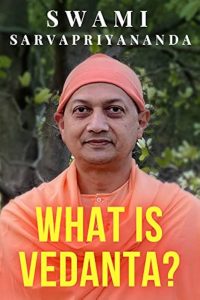
This page is intended as a learning resource for educational purposes and meant to offer an overview/introduction. Short quotes aren’t a substitute for source material, so if this page sparks your interest, explore more deeply by checking out Swami Sarvapriyananda’s books (Amazon). I’ve read three of them so far and plan on reading more soon. Quotes below are paraphrased unless shown with “quotation marks.”
The Two Spiritual Approaches: God & Self (Swami Sarvapriyananda Summary)
Overview:
There are two broad approaches to spiritual life:
1. Search for God / ‘that’-centered approach
2. Inquiring into the Self / ‘thou’-centered approach
God-Centered Spiritual Approach (That):
If you ask the question, ‘What is the reality about this universe?,’ that is the search for God.
Overview:
- Likely to be dualistic, devotional, ritualistic, worship-oriented, and temple/church/mosque-oriented. You are likely to see lots of worship, joyous celebrations, music, food, etc. All the Abrahamic religions are God-centered, theistic religions. This is the only kind of religion that the Western world has known. People in the West find something like Buddhism very confusing. They question how there can be a religion without God, whereas in India this is not a problem at all.
Sarvapriyananda says:
- “The great disadvantage of a God-centered approach, especially in today’s world, is that the God-centered approach starts with—and proceeds with for a long time—faith/belief. If you start with questioning and skepticism, it’s very difficult to follow the God-centered approach.”
Self-Centered Spiritual Approach (Thou):
If you ask the question, ‘What is the reality about myself?’ (or ‘Who/What am I?’), that is an inquiry into ‘thou’ (the individual).
Overview:
- More monastic in nature, more inquiry-based, more introspective, more intellectual, meditative rather than devotional, more meditation hall-oriented rather than temple-oriented. There are religions and systems like Buddhism, Jainism, Sankhya and Yoga that are based on Self-inquiry.
Sarvapriyananda says:
- “Notice how much effort is put forth in trying to convince others and yourself God exists. In contrast, nowhere you will find any effort put forward to prove that I exist. Nobody really doubts his or her own existence. If you doubt, then who is the one doubting? That one exists … The advantage of the thou-centered approach is that there’s no doubt that I exist. But the problem is this: I exist, but my existence is a miserable existence.”
Synthesizing God & Self Spiritual Approaches:
You investigate these two polarities: the analysis into ‘Who/What am I?’, and an analysis into ‘What is God?’. Then you come to a synthesis that brings them together. The great insight of Advaita Vedanta is: the reality you reach through the God-centered approach and the reality you reach through the Self-inquiry approach are the same reality.
Overview:
- Advaita Vedanta in one sentence: Tat Tvam Asi / That Thou Art / Atman is Brahman.
- ‘That’ (that which is worshipped as God/the reality behind this universe) = ‘Thou’ (you the individual).
- ‘Atman’ means the Self itself—Who I am, what I am—right here, right now.
Sarvapriyananda says:
- “By bringing them together, the stunning insight is that indubitable personal existence is also the infinitude of God. The unproblematic, infinite nature of God and the indubitable certain existence of the Self are brought together … Once we realize this, once we come to know it and we see it as a living reality, at the deepest level all our problems are solved.”
Bonus:
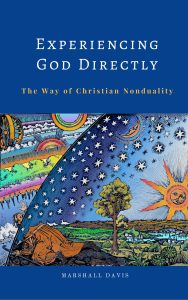
Interestingly, the same idea is mentioned from a Western perspective in Experiencing God Directly: The Way of Christian Nonduality by Marshall Davis:
- “There are two basic approaches to Divine Truth. One is self-inquiry, relentlessly pursuing the question, ‘Who am I?’ until the answer is experienced directly and immediately. When we see who we truly are, we see who God truly is. The other way is to ask ‘Who is God?’ When we know God, then we know ourselves. The first approach is most commonly used in Eastern spiritual traditions. The second approach is found in Western traditions. An equivalent question asked by Christians is ‘Who is Christ?’ There are two ways of understanding Christ: Christology from below (beginning with Jesus’ human nature) and Christology from above (starting with his divine nature). When it comes to spiritual inquiry, East starts ‘from below.’ asking ‘Who am I?’ West starts ‘from above,’ asking ‘Who is God?’ … The Incarnation combines both the ‘from below’ and the ‘from above’ approaches. Because Christ was a human being, it is an inquiry into human nature. Because Christ is Divine, it’s also an inquiry into the nature of God.” — Marshall Davis (Experiencing God Directly)
You May Also Enjoy: