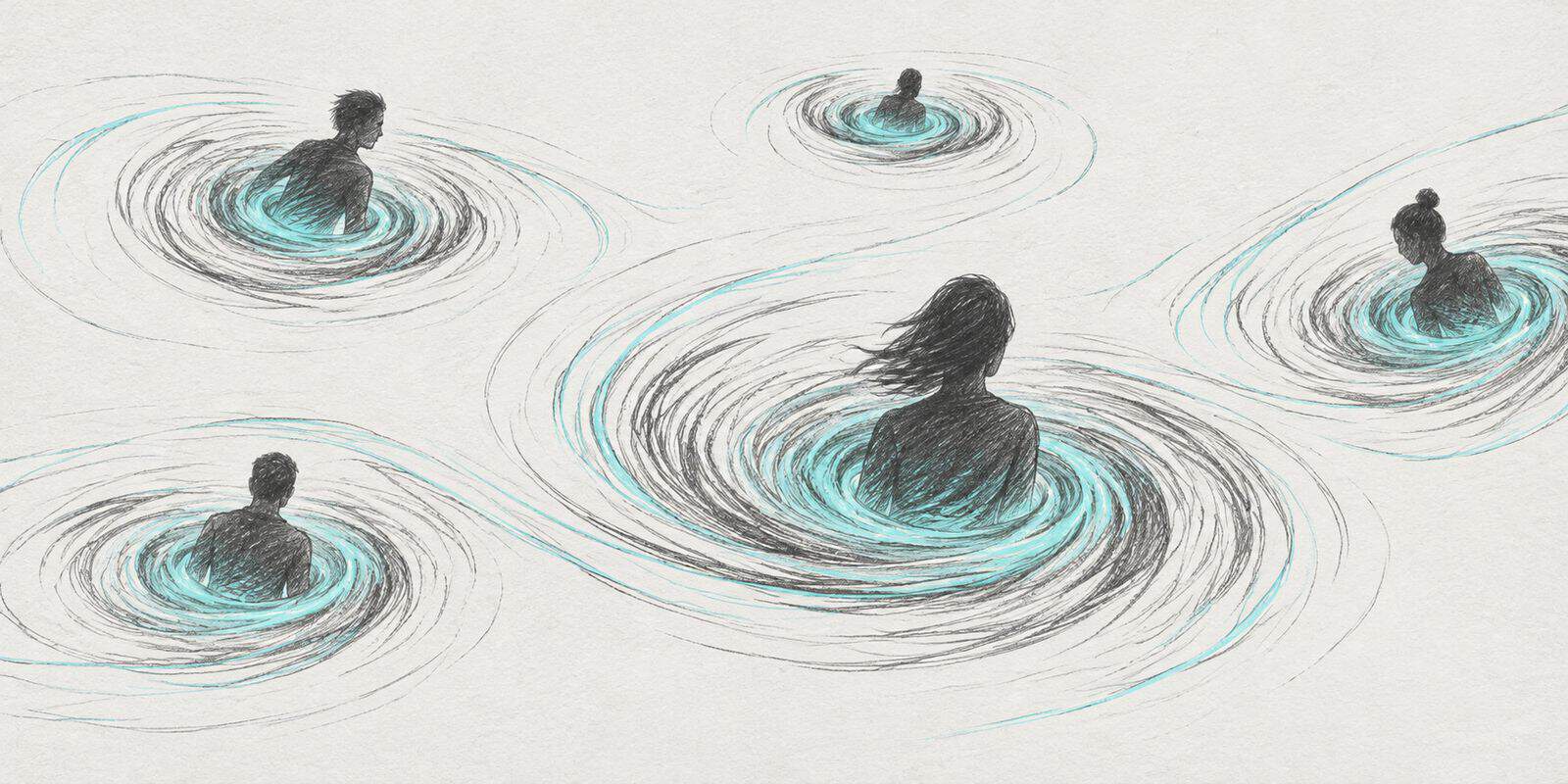
Have you considered yourself as a whirlpool? This seems to be a popular analogy mentioned by some great minds like Alan Watts and Bernardo Kastrup (paraphrased and summarized below).
This page is intended as a learning resource for educational purposes and only meant to offer an overview/introduction. Short quotes aren’t a substitute for source material, so if this page sparks your interest, explore more deeply by checking out the books of Alan Watts (Amazon) and Bernardo Kastrup (Amazon).
On People as Whirlpools (Alan Watts & Bernardo Kastrup Summary)
Alan Watts on People as Whirlpools:
“The whirlpool is something the stream is doing, and in exactly the same way, the whole universe is doing each one of us. And I see you today, and I recognize you tomorrow, just as I would recognize a whirlpool in a stream. I’d say, ‘Oh yes, I’ve seen that whirlpool before. It’s just near so-and-so’s house on the edge of the river, and it’s always there.’ So in the same way, when I meet you tomorrow, I recognize you; you’re the same whirlpool you were yesterday. But you’re moving. The whole world is moving through you.” — Alan Watts
- On whirlpools: In the whirlpool in water, there is no constant water, there is only going on a continuous behavior: whirling in the water. The whirlpool is a definite form, but no water stays put in it. The actual water is constantly flowing through the whirlpool and there is no stuff permanently in the whirlpool. The whirlpool is a pattern: it’s something the water is doing. The whirlpool is constant only in its doing, that is to say in its whirling. And, you could recognize individual whirligigs in a stream, but the water is flowing through them all the time. They are never the same for a second. There is no thing that whirlpools, there is the whirlpool.
- On life as a whirlpool: Life moves along like water, and it’s all connected as the source of a river is connected to the mouth and to the ocean. And all the events—or things—going on are like whirlpools in the stream. Because you go there today and you see a whirlpool. You go there tomorrow and you see a whirlpool. But it isn’t the same whirlpool because all the water is changing every second. What is happening is not really what we should call a whirlpool but rather a whirlpooling. It is an activity, not a thing.
- On people as whirlpools: You yourself are not so much an entity that moves around in an environment. You are much more like a whirlpool in a stream. The whirlpool is something the stream is doing, and exactly the same way the whole universe is doing each one of us. Just as a whirlpool in a river is a whirling of streaming water—there is no thing that whirlpools—in the same way each one of us is a very delightfully complex undulation of the energy of the whole universe. We are a constant pattern of physical energy in which nothing stays put. You flow. You are a process.
- The human body as a whirlpool: A human body is like a whirlpool, there seems to be a constant form, called the whirlpool, but it functions for the very reason that no water stays in it. The very molecules and atoms of the water are also ‘whirlpools’—patterns of motion containing no constant and irreducible ‘stuff.’ Every person is the form taken by a stream—a marvelous torrent of milk, water, bread, beefsteak, fruit, vegetables, air, light, radiation—all of which are streams in their own turn. Everything outside you is sort of creating you by flowing through you and human-ing, body-ing; just as, when the river moves, it whirlpools and then goes on. Every one of us is a whirlpool in the tide of existence, and wherein every cell in our body, every molecule, every atom is in constant flux, and nothing can be pinned down. We know that the cells in the human body are completely changed within at least seven-year periods. So, who are you?
- The human mind as a whirlpool: There is a stream of thought and feeling going on, just like there is a stream of water going by, and that’s you. It’s an organized stream just in the same way that when you see a whirlpool in a river, it’s organized, it’s recognizable, it has a shape. And it has an enduring shape, even though it is a constant flow. You are clinging to the idea of your continuity. Actually, there is only the moment, the instant—what is called in Sanskrit the kṣaṇa: life is instantaneous.
Bernardo Kastrup on Ripples & Whirlpools:
The analytic idealist does not differentiate experience from the experiencer; there is only the universal experiencer, all experiences being but patterns of excitation of the universal experiencer.
- Nature is one field of subjectivity (or ‘experience,’ ‘mentation,’ ‘mind,’ ‘subjectivity,’ ‘subject’) whose ‘ripples’ (particular patterns of excitation) are particular experiential states: Each different ripple (pattern of excitation) is a discernible, countable experiential state. That’s how the unfathomable variety and complexity of natural states is accounted for in terms of the simplicity of one field of subjectivity (the one subject of nature can ‘oscillate’ differently so to produce what is represented on our cognitive dashboard). Experiences are but excitations of the field, there being nothing to experience but the field (just as there is nothing to a ripple but the river).
- In addition to ‘rippling,’ the one field of subjectivity that nature is can also form ‘whirlpools’: It can configure itself, spontaneously, so to form highly localized patterns of excitation that turn in upon themselves and become seemingly distinct from their surroundings. This is how we can visualize dissociation over a field: a particular alter in the mind of nature is akin to a ‘whirlpool’ in the ‘river’ of natural mentation. An alter is still a segment of the field just as a whirlpool is still a segment of the river.
- There is nothing but the field of subjectivity that nature is, just as there is nothing to ripples and whirlpools but the river water in movement: When we find a whirlpool in a river, we can precisely determine its location and delineate its boundaries, and point at it and say, ‘There’s a whirlpool!’ (just like we can point at an alter of nature and say, ‘There’s a person!’). Yet, there is absolutely nothing to a whirlpool but the river, in movement. In precisely the same way, there is nothing to an alter of the mind of nature but the mind of nature. The whirlpool is not a thing, but a doing of the river. The alter is not a thing, but a doing of nature (and this particular kind of doing is what we call a dissociative process).
- The mind of nature (which is what nature is) is omnipresent, omniscient, and omnipotent: It is omnipresent because, since nature is this mind, the mind is necessarily everywhere in nature. It is omniscient because the defining characteristic of a mind (of a field of subjectivity) is that it is sentient. And it is omnipotent in the sense that, whatever happens in nature, happens necessarily because of an action (an excitation, a ‘movement,’ an ‘oscillation,’ a ‘ripple’) of the field of subjectivity that nature is. If these three attributes are sufficient, in your view, to qualify the field of subjectivity as divine, then I suppose it’s okay to call it ‘God.’
A final thought from Francis Lucille:
- “Everything we do from moment to moment is conditioned by the past or, if you will, by the current state of the universe. We are like a whirlpool in the river. We don’t have an individual separate existence. Our individual separate existence, and as a result our freedom, is an illusion. It is the way the river moves.” — Francis Lucille
You May Also Enjoy: