Douglas Harding described the headless way stages in various ways. This post summarizes a few of them.
This page is intended as a learning resource for educational purposes and only meant to offer an overview/introduction. Short quotes aren’t a substitute for source material, so if this page sparks your interest, explore more deeply by checking out Douglas Harding’s books (Amazon).
The Headless Way Stages (Douglas Harding Summary)
Headless Way Stages Explanation #1
The following is the “8 x 8-fold Plebeian Path” from The Trial Of The Man Who Said He Was God:

Headless Way Stages Explanation #2
The following explanation comes from the short video of Douglas Harding below…
1. The Newborn Baby:
1st person; space for the world to happen in; admittedly the world of the 1st person here for the baby is chaotic and ill-organized.
“The newborn baby is for itself not newborn baby at all. All its arrows of attention are that way (pointing outward). It is not out there looking at itself saying, ‘What a nice little baby I am.’ It has absolutely no arrows of attention going back (pointing inward) to be self-conscious … The newborn baby is really living from being, living from this immensity, living from the 1st person. We are all born here: 1st person.”
2. The Young Child:
Who is for others what he looks like, but for himself when fancy-free and not under criticism he is as wide as the world.
“We grow up a little bit and become toddlers and young children, and we have many faces around us—our parents, and brothers and sisters, and so on—and among the faces around us is a face in the mirror. The face in the mirror is the face of a baby, of our friend. It’s not one’s own face. Never, never, never does a young child naturally look in the mirror and say, ‘That’s me.’ Absolutely not. It’s always my friend, my playmate. But, parents have a job which is to say, ‘That’s you in the mirror!’ And, of course, one doesn’t want to be left out in the cold. One would agree to any crazy proposition in order to be not thrown out of the club. So, in order to belong to the human club, I would agree, ‘Yes, alright, that’s me there’ … But, when I’m on my own, and happy, and playing, and wandering along the beach fancy-free, I’m not like that at all. I’m still 1st person. I’m still immense and living from my space just as I was when I was a newborn baby. So, a marvelous time of my life is stage two which is the young child who is for himself still as wide as the world, though for others he’s joined the human club and says, ‘I am what I look like’.”
3. The Adult:
I am what I look like; that’s hell; what I look like is dying, what I am isn’t.
“Dark night falls, and we enter the third stage: ‘I am what I look like.’ I’ve lost my space; now become my face. Is it any wonder that teenagers are angry having been shrunk from being as wide as the world into being a little thing here? It’s no wonder at all. Shrunk from what they are into what they look like. It lost their immensity. That thing in the mirror has come and invaded them here which is illegitimate and nonsense and untrue. And, nearly all of us stay at that third stage of our lives. Tragic.”
4. The Seer:
You’ve got what I look like, I’ve got what I am; I’m going to live from that; that’s where I operate from.
“The fourth stage is when we get this thing here (motions to his face) and put it back where it belongs. Just as Jesus says, ‘Unless you become as little children, you will never enter the kingdom’ … The fourth stage is to see the thing in the mirror is what I am for others, here is what I am for me.”
Headless Way Stages Explanation #3
The final explanation comes from: “On Having No Head” by Douglas Harding.
“The experience has of itself opened out into a Path (the Headless Way is as good a name for it as any), and much has been learned about this Path – its twists and turns and traffic flow and traffic blocks, its general practicability. A map of it all, from the very beginning is long overdue.”
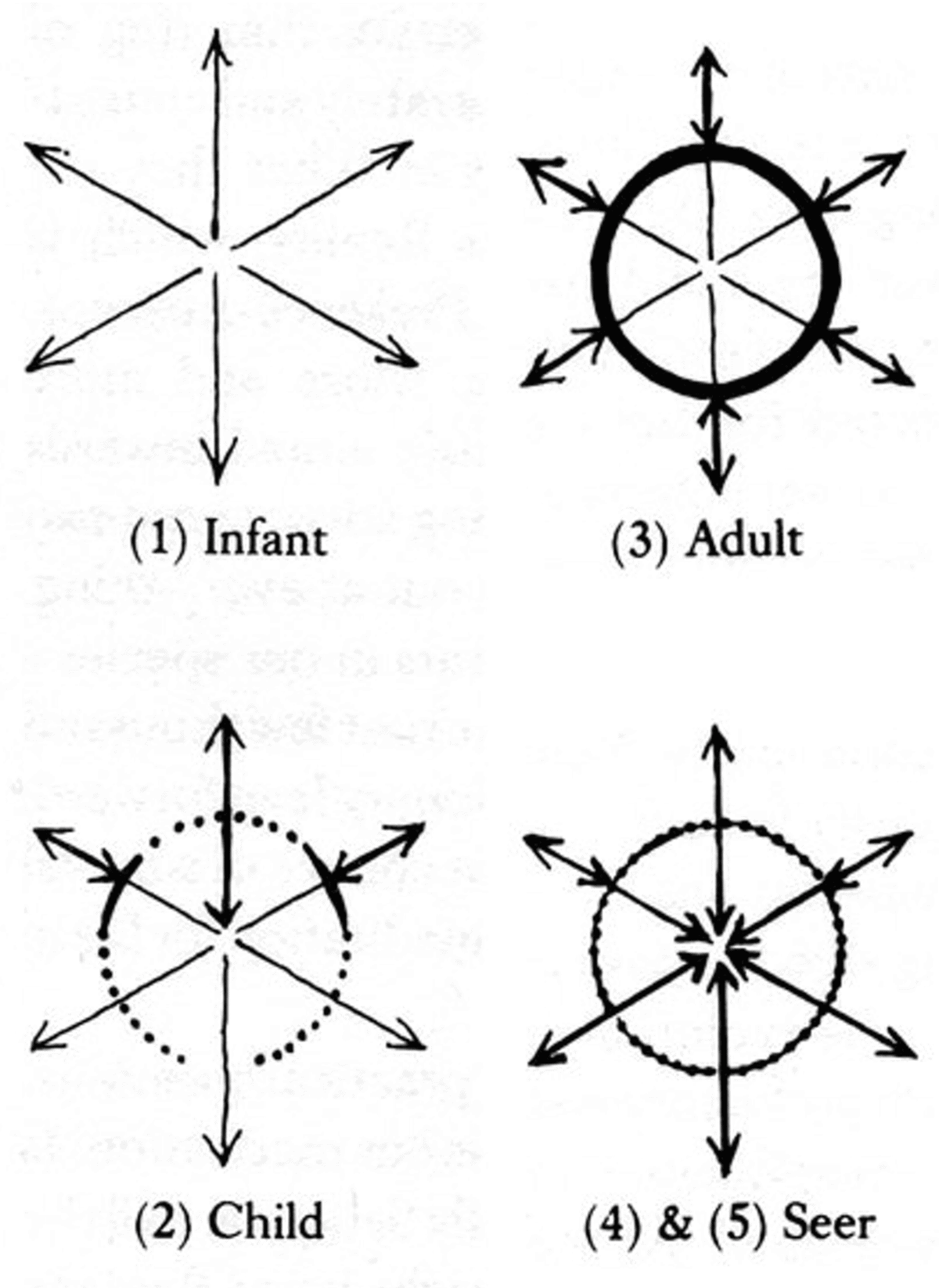
1. The Headless Infant:
“As the animal and infant of Stage (1), you were unselfconscious: all your arrows of attention were aimed outwards: you overlooked your presence.”
“As an infant you were like any animal: in that you were for yourself headless and faceless and eyeless, immense, at large, unseparate from your world – without being aware of your blessed condition. Unconsciously, you lived without obstruction from What you are Where you are, from your Source, and relied simply on the Given.”
2. The Child:
“As the child of Stage (2), you probably were from time to time truly Self-conscious; on those occasions an arrow of attention was turned inward also, and it hit the mark: you saw your Absence – accidentally as it were. But more and more your inward-pointing arrows fell far short of that mark: instead of getting through to the central Absence-of-any-body they got stuck in the peripheral presence of a very human somebody.”
“Gradually you learned the fateful and essential art of going out and looking back at yourself, as if from a few feet away and through others’ eyes, and ‘seeing’ yourself from their point of view as a human being like them, with a normal head on your shoulders. Normal yet unique. You came to identify with that particular face in your mirror, and answer to its name … At this stage you come near to making the best of both worlds – the unlimited non-human world you are coming from and the limited human world you are entering. All-too-briefly, you have in effect two identities going, two versions of yourself.”
3. The Headed Grown-up:
“As the adult of Stage (3), and falsely self-conscious, you went on aiming your arrows of attention at that insubstantial some-body, at that human appearance of yours which daily became more substantial for you, and soon was your identity card, your identity itself. (Forged card, mistaken identity!)”
“It seems that, from a very early age, our learned view of ourselves from outside begins to overshadow, to superimpose itself upon, and eventually to blot out, our original view of ourselves from inside. We have grown down, not up. Instead of being present and together with the stars – and all things under the stars – we have shrunk away and withdrawn from them. Instead of containing our world, it now contains us – what’s left of us. And so, reduced from being the whole scene into being this tiny part, is it any wonder that you and I find ourselves in all sorts of trouble – if we grow greedy, resentful, alienated, frightened, defeated, tired, stiff, imitative instead of creative, unloving, plain crazy?”
Q&A:
The Big Question: “Is Stage (3) – this stretch of road so paved with delusion-based suffering – just a great mistake, an unnecessary loop which can and should be by-passed? Is it possible to leap – helped on by enlightened parents and teachers – from the childhood of Stage (2) to the true adulthood or seership of later stages, thus avoiding the worst of the troubles we have just listed? In other words, can one become a full member of this club called Human Society, and enjoy its inestimable privileges and facilities, yet without ever subscribing to the lie on which it is founded, without ever joining in the club’s non-stop Face Game, without ever becoming like them?”
The Answer: “There’s no route from the Paradise of childhood to the Heaven of the blessed that doesn’t lie through the Far Country, through some kind of Hell or at least Purgatory. Really to turn away from our wilfulness, to abandon our personal and separative ego (and so come to the later stages of our journey) we must at this stage be paid-up members of the society which is dedicated to their cultivation: as small children our egocentricity is as yet too shallow, too ineffectual and variable and candid, too little ours, for us to give up. Really to lose our heads, we must first have them firmly in place. Really to appreciate What we are, with clarity and impact, we must first be identified with what we are not. Really to value the perfectly obvious, we must first acquire the habit of overlooking and denying it. The Universe is such that true liberation doesn’t happen in vacuo; it is liberation from what’s false – without which it isn’t liberation at all.”
4. The Headless Seer:
“All one has to do to enter this Fourth Stage of the journey is – however briefly – to turn round the arrow of one’s attention … What you are now looking at is this printing; what you are now looking out of is empty Space for this printing. Trading your head for it, you put nothing in its way: you vanish in its favour.”
“This seeing into one’s Nothingness is always on tap, whatever one’s mood, whatever one is up to, however agitated or calm one happens to be at the moment – in fact, just whenever one needs it … This alone is real seeing. It can’t be done wrong, and is quite foolproof … Though down the centuries this in-seeing has been made out to be the most difficult thing in the world, the joke is that it is really the easiest … This experience is uniquely communicable, because it is exactly the same for all – for the Buddha, for Jesus, for Shen-hui, for Al-Alawi, for you and me.”
5. Practicing Headlessness:
“As the seer of Stages (4) and (5), you are again truly Self-conscious: but this time you penetrate that ring of appearances more deliberately and consistently, and begin to rest in What they are appearances of, in your Reality, which is your true Identity, your Presence-Absence, your Core and Source.”
“More and more often your arrows of attention, simultaneously aimed inwards and outwards, hit their mark. You are becoming adept at two-way looking – at once looking in at No-thing and out at every-thing … Now the ‘hard’ part begins, which is the repetition of this headless seeing-into-Nothingness till the seeing becomes quite natural and nothing special at all; till, whatever one is doing, it’s clear that nobody’s here doing it. In other words, till one’s whole life is structured round the double-barbed arrow of attention, simultaneously pointing in at the Void and out at what fills it. Such is the essential meditation of this Way.”
6. Working It Out:
“We have to go on to discover much more about the meaning of headlessness, its value for living, its drastic implications for our thinking, our behaviour and relationships, our role in society. This stage, even less clear-cut than the others, is bound to overlap them to a large extent, and in fact is never finished with. There is no standard pattern.”
“No matter how revolutionary the discoveries made along Stages (5) and (6) of the Way, or how valuable for living they are beginning to prove, in the end they leave the wayfarer profoundly unsatisfied. There remains an ache, an undefined longing. In spite of all this quite genuine spiritual ‘progress’, an all-important region remains untravelled, or at least insufficiently explored. It’s a dark and dangerous country inhabited by monsters, and it cannot be by-passed. It is the area of the will. Here, beyond and beneath all these luminous goings-on, the unregenerate ego is still at work, possibly beavering away more vigorously than ever.”
7. The Barrier:
“We come to Stage (7) of our Way, which looks much more like a dead end or impassable obstruction than what it is in fact – the really testing stage of the journey, painful but obligatory.”
“The barrier is none other than the culminating defense-effort of our wilfulness or ego, its most formidable but desperate stand against sustained attack by the inescapable facts; and what overcomes it is more and more of the same realism, the same thankful reverence for What’s So – for the Plainly Given, the Blatantly Obvious – that brought us all the way up to the barrier … The true route lies straight into and eventually through the Barrier, which our Western tradition calls the Dark Night of the Soul … In a certain sense, this is the real start of the Way, of the true spiritual life, which is nothing else than self-surrender, self-abandonment, actually underwriting whatever happens to one, dying as the separate and illusory ego (I am a somebody) and being reborn as the one and truly egoless Ego (I AM) … A dreadful thought haunts one: was all that spiritual ‘progress’, all that effort leading up to this Barrier, a waste of time, even fraudulent? … It could be said that all spiritual ‘progress’ up to this point was merely preparation for this, the essential and by far the hardest stage of the Way, leading eventually to the Breakthrough.”
8. The Breakthrough:
“This amounts to a profound declaration of intent. It is the realization at gut level (so to say) that one’s deepest desire is that all shall be as it is – seeing that it all flows from one’s true Nature, the Aware Space here.”
“It’s not a doing, but an undoing, a giving up, an abandonment of the false belief that there’s anyone here to abandon. What else is there to do? After all, one’s initial in-seeing – no matter how ‘brief’ and ‘shallow’ – was already total self-surrender: everything here went: or rather, it was clear there’s nothing here to go. It was the essential quantum leap from the fiction of egocentricity to the fact of zerocentricity … In terms of our Western tradition, our breakthrough is our unconditional and ever-renewed surrender to God’s will as perfectly revealed in our circumstances – to God’s will clearly on show all around us and within us, in the shape of all that’s going on right now. Insofar as his will becomes ours, we see his world as it is; and, insofar as we see it as it is, our will becomes his and from our hearts we welcome all that world is bringing to us. Here, in short, our seeing and our willing merge – not once-and-for-all of course, but moment by moment, so long as life lasts … Where do we go now? The answer is: nowhere. Let us resolutely stay right here, seeing and being This which is Obviousness itself, and take the consequences. They will be all right.”
You May Also Enjoy: